Showing posts with label canning. Show all posts

Wednesday, August 13, 2025

Insane canning advice...?

The other day I was reading a sensible and well-written piece by Daisy Luther ("The Organic Prepper") about the dangers of using pressure cookers for canning.

She also emphasized the need to use a pressure canner when preserving low-acid foods. She wrote: "Pressure canning exceeds the temperature of water bath canning, getting your product into the safety zone.  The temperature must reach 240 degrees Fahrenheit, which can only be achieved through steam under pressure. All vegetables (except for tomatoes which are botanically a fruit), meats, seafood, and poultry, must be preserved in a pressure canner."

All truthful and factual information. No argument from me.

But then I read something in the comments that absolutely floored me. Someone named "William C" wrote: "There are other ways to get water to 240 degrees without using pressure. Antifreeze added to the water, and checked with a radiator hydrometer, will raise the boiling temp to as much as 270 degrees. Also, you can skip the water bath and use cooking oils. They can get to over 400 degrees if you want."

I'm sorry, is he suggesting we submerge our green beans or chicken breasts in a water-bath mixed with antifreeze? Deadly poisonous antifreeze that routinely kills pets?

Or, just as crazy, that we "skip the water bath" and submerge the jars of food in boiling-hot cooking oils?

With all due respect to William C., this has to be some of the most lunatic and insane canning advice I've ever heard, even worse than those who claim it's safe to water-bath can green beans "because Granny always did it that way."

I read William C's recommendations out loud to Don and we hashed out the insanity of the man's advice. Don summed it up succinctly: "Or you can just get a d*** pressure canner, for Pete's sake."

Couldn't have said it better myself.

Thursday, January 30, 2025

Let's gleefully flirt with death!

It happened again. Will people never learn?

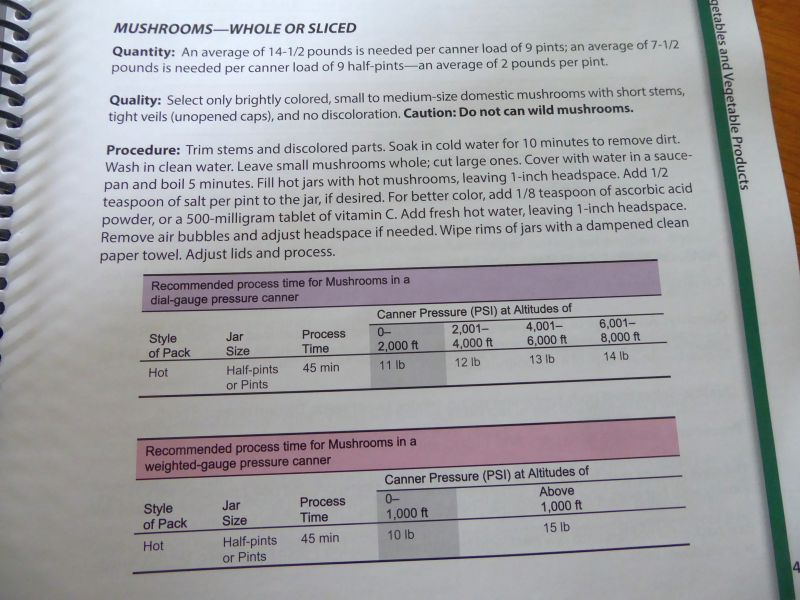
I just received a comment on an older blog post about canning mushrooms.

I'm sure you can guess what it was about. To quote: "While looking up recipes to water bath can mushrooms, your above comment came up in the search. My Grandmother, my mother, my mother-in-law and myself, have only ever water bathed veggies. I'm surprised it's not the norm anymore."

It's "not the norm anymore" BECAUSE IT'S DANGEROUS. I'm honestly at a loss why someone would come onto this blog and condescendingly lecture me about their unsafe canning methods, but there you go. As my readers know by now, low-acid foods MUST be pressure canned to kill botulism spores.

The last time I posted about this frustration, a reader noted, "Maybe telling others what [botulism] actually is and how it can affect someone instead of just saying it is dangerous might help?" and helpfully supplied the following information (source unknown):

Botulism: a paralyzing nerve toxin, considered to be one of the most potent and lethal substances in the world. It's produced by the bacterium Clostridium botulinum and sometimes by strains of Clostridium butyricum and Clostridium baratii. The rod-shaped bacteria are commonly found in soil and sediments from lakes, rivers and oceans. The bacteria thrive in low-oxygen conditions, such as canned foods, deep wounds & the intestinal tract, but when threatened form protective spores with a hard coating that allows the bacteria to survive for years.

The danger is not from the spores themselves but what they produce while germinating. As the C. botulinum bacteria grow, they create eight types of neurotoxins that are so deadly, even microscopic amounts can kill.

Because botulism toxin paralyzes muscles, early and classic signs of the illness are drooping eyelids and blurred or double vision, dry mouth, slurred speech and difficulty swallowing. If left untreated, greater paralysis of muscles of the arms, legs and trunk of the body will occur, affecting the ability to breathe.

Babies infected w/botulism will be poor feeders & seem lethargic, w/weak cry & poor muscle tone, can also be constipated.

Botulism does not cause fever; those affected are usually alert and aware of their surroundings. Once botulism is confirmed, it can be treated with an antitoxin and, in some cases, antibiotics. If the antitoxin is given before paralysis is complete, helps shorten recovery, which requires regrowth of motor nerve endings. Patient can be hospitalized for supportive treatment/ventilator, for weeks or months until paralysis improves. In some cases, muscle weakness & shortness of breath can last years.

But I know I'm talking to a brick wall with some people. Whee, let's gleefully flirt with death! This person is going to water-bath can her mushrooms and other veggies, and someday will be shocked – shocked! – when a family member is hospitalized with this deadly toxin. You can lead a horse to water......

Sunday, March 10, 2024

Here's how to tick off a reader

Sigh. It happened again. I ticked off a reader. The subject – you guessed it – is pressure canning vs. water-bath canning.

This is the comment, which came in on an older blog post about canning bacon bits. Someone had asked, "Can you do them in a water bath if you don't have a pressure canner?" I replied, "Absolutely NOT. Bacon (and all meat) is low acid, so it MUST be processed in a pressure canner. Don’t let anyone tell you otherwise. Boiling meats in a water-bath for ten hours cannot replace pressure. Do not risk botulism by processing meats or other low-acid foods in a water-bath. If you’re serious about preserving food, it’s worth investing in a pressure canner and learning its proper usage."

And that, I thought, was that ... until this morning, when a comment came in as follows: "Yes don’t let anyone tell you NO! This is how it’s been done before pressure canners were invented, meats are 3 hrs boiling with water 2” over jars. Theirs [sic] many groups on FB [Facebook] that will teach you how.. Blessings."

And, once again, I lost it – and no doubt ticked off the reader as a result. Here's what I replied:

"WRONG. Why do you think pressure canners were invented in the first place? It was because scientists learned boiling water doesn't kill botulism spores. Three hours – ten hours – a hundred hours in a water bath will NOT render low-acid foods safe. WHY CAN'T PEOPLE GRASP THIS CONCEPT???!!! Do you refuse to wear a seat belt while driving as well because cars were invented before seat belts?"

Arrgghh. It is SUCH a simple concept, time-tested and scientifically proven, and yet people will blithely continue to endanger their families by water-bathing low-acid foods.

Don urges me not to spike my blood pressure and just let such comments go. But I can't. I just can't let someone come onto this blog and spread the notion that unsafe canning practices are fine.

Tuesday, February 27, 2024

Jar washer fix

I've been doing a fair bit of canning lately, and that means washing a lot of jars.

Years ago, I bought a nifty little device for washing canning jars: basically, sponge pieces at the end of a plastic stick. I use this jar washer so frequently that I stopped putting it away when dry and just keep it permanently in the utensil rack of my dish drainer.

The only trouble is the original sponges were cheap. They were crumbling and falling apart and not wanting to stay within the prongs of the holder. As a result, the jar washer didn't do as good a job cleaning the insides of jars.

So I purchased a large plain sponge with an eye toward replacing the original (and cheap) sponge pieces that came with the jar washer.

I asked Don what would be the best method for cutting the sponge. Knife? Box cutter? He suggested the band saw, so he took the sponge to the shop and sliced it up into pieces approximating the size of the original sponge pieces.

I folded one piece and wedged it between the prongs.

A hundred percent improvement!

It's the little things in life, y'know? The fact that I keep this jar washer permanently in the drain rack is a testament to how frequently I use it. With the extra slices from the sponge, this humble tool should last me the rest of my life. Win-win!

Wednesday, January 17, 2024

Is safe canning a government conspiracy?

As many long-time blog readers know, I'm a fanatic when it comes to safe canning practices.

I've been canning for over thirty years, and I adore it. However there was a dark period in my canning career when I got cocky and overly confident, and jokingly called myself the Invincible Canner. As many of you remember, I got knocked off that pedestal after doing some research on the issue of canning refried beans. You can read all about it here.

That blog post, dating back to 2012, received dozens and dozens of comments ... and they're still trickling in. Last June, I received a comment to the effect that pressure canning isn't necessary since "two to three hours in a water bath will do anything." NO IT WON'T. I put up a rant about that comment here.

And still the debate continues. Why can't people accept that unsafe canning practices exist? Why?

More recently I received the following comment:

"Most of you are part of the public Government Watch Dogs ready to pounce upon anyone not doing what government tells you. This is the United States of America where people have individual Rights of Life, Liberty and Pursuit of Happiness to live their life as they choose providing they don’t harm anyone else. People have preserved foods in many ways prior to your food scientists. Government is always there to interfere in that process, just like they did in the 1930’s taking your Right to Travel in a Horseless Carriage away and give you a license. That was part of their New Deal. Most of you are Sheep but you’re entitled to your opinion as I am also. Those who want to Rebel Can their food are not hurting me or you. And they have Rights also!"

I'm sorry, what? Safe canning practices are now a government conspiracy to enslave you against your will?

Look, if you want to water-bath your green beans, I'll call you a fool but I won't sic the government watch dogs on you (although I will feel sorry for your family members who potentially could be harmed by eating incorrectly canned food). However if you try to sell your badly canned green beans to the public, that's illegal – with good reason. It's a dangerous and unsafe practice.

I have very little tolerance for government interference in personal liberties, but I have no quarrels with USDA canning guidelines (read this post for a better understanding of why).

So I suppose you can claim I'm part of a "conspiracy" to prevent you from incorrectly canning your green beans. Whatever.

Happy canning.

Wednesday, September 6, 2023

Squee! My birthday present!

Today is my 61st birthday. We spent it doing something very exciting: Bringing the car into an auto-repair center to have a cracked windshield replaced. Whee.

But on the way home, we stopped and picked up my birthday present, and I'm giddy with delight.

Let me back up and explain. For decades, I've used a trio of large pots for water-bath canning.

The two smaller pots (3-gal. and 4-gal.) were given to me by my mother a long, long time ago, at least 25 years ago. I have used these pots for every conceivable kitchen project under the sun, including water-bath canning.

I picked up the largest pot (it's not marked, but I'm guessing it holds 5 gallons) at a yard sale some time later. It's of cheaper construction and proved it by splitting a few years ago when I tried to pick it up when it was full. It kinda "buckled" in on itself.

These cracks are on both sides of the pot and have gotten deeper over time, to the point where I can no longer water-bath quarts because the water will seep out the cracks when I add enough to cover the jars.

The pots my mom gave me are in great shape, but they're juuuust a bit too small for effective water-bath canning. When I fill them with water an inch over the top of quart jars, the pots are so full that water tends to splash out once it achieves a rolling boil. Plus, one pot holds only five quart jars, the other holds four quart jars, making for longer canning sessions since I can only can nine quarts at a time.

So earlier this week while canning peaches and blueberries, I expressed my frustration to Don. "I've made an executive decision," I said. "I'm buying a proper water-bath canner." I showed him the splits in the largest pot, and why the smaller pots tend to splash during canning, and he agreed such a purchase was massively justified (and overdue).

A brief bit of online research showed many water-bath canners were sold as kits, something I most definitely didn't need since I already have all the other accouterments.

But coming through town today, we stopped at the local hardware store and found exactly what I wanted: two water-bath canners. They cost $29 each.

Each has its own rack.

And look – they hold seven quarts apiece! And they're plenty deep to properly immerse the jars during a rolling boil!

Honestly, I'm giddy. Thrilled to my toes. Like a kid at Christmas. I've been water-bath canning for over 33 years and never had the proper equipment. What took me so long to get these?

Ironically, after this week's canning frenzy, I don't have anything more to water-bath can this season. But I'll be all set for next year. Woot! What a birthday present!

Canning frenzy

The trouble with canning, I've found, is once I start, it's hard to stop.

It began with peas. While cleaning out and inventorying our chest freezer, I came across two gallons of peas from the garden in our last place. At the time I harvested them, we were selling the house. It was a busy summer and I didn't have time to can anything, so I put them in the freezer ... and forgot about them.  Those were the first things to get canned.

Then, a couple days later, Don and I were driving through a nearby town when we saw one of those traveling fruit vendors. Instantly we pulled over and purchased two boxes of peaches (which, let the record show, had fewer quantity and higher prices than past purchases; but yowza they were delicious!). We had been trying to chase down this fruit vendor for several weeks, but didn't know his schedule. (Now we have his business card.) From this bounty, I canned up 15 quarts of peaches; the rest we ate fresh. Peaches are – hands down and by a wide margin – my all-time favorite fruit.

Lastly, of course, I canned the blueberries.

I'm also washing and selling some surplus canning jars that didn't sell at the yard sale. Most of these are half-pint jam and jelly jars, which I simply don't use.

Have I mentioned how much I love fall? Canning and autumn are forever entwined in my mind.

Hmm .... what can I can up next? Hopefully by this time next year, our garden will be up and running, and I'll have lots more ways to celebrate fall.

Thursday, June 29, 2023

"Two to three hours in a water bath will do anything"

Okay, confession time: I just "lost it" on a blog reader. Forgive me as I rant a bit.

Eleven years ago, I put up a post called "The Invincible Canner" which chronicled my canning education, specifically how I got knocked off the self-built "invincible canner" pedestal I had put myself on, and learned some humility. Go on, go read that post. I'll wait.

Now that you're back, you may have noticed that post received a lot of comments – nearly 100. It was a lively discussion from many people interested in canning, both newbies and experienced.

And it's still getting comments. One came in yesterday afternoon as follows:

"I find this all so funny since the Amish have never used pressure canners, but can meat, milk, eggs and pasta all with water bath canners! Cleanliness and two to three hours in a water bath will do anything. I've been doing it myself as well. Haven't lost anyone to botulism yet!"

And I confess ... I lost it. No matter how much you try to educate someone about something as critical as food safety, they'll still dismiss it – tra la la – as immaterial. "Two to three hours in a water bath will do anything." NO IT WON'T. But I guess this person thinks they're special and the laws of science don't apply to them.

"Just let it go," Don suggested when I read the comment out loud to him. But I can't. I simply cannot stand by and watch someone promote something as unsafe as water-bath canning low-acid foods.

So I replied. Here's what I wrote:

"Well, if you're going to completely disregard the proven science behind canning, I suppose there isn't a lot I can do to change your mind. It's like driving without a seat belt; most of the time you'll be fine ... until you're not. Personally I don't want to play Russian roulette with the safety of my canned food, so I'll continue to follow USDA guidelines for safe canning procedures."Oh, regarding the Amish: A few years ago, my daughter and I were in Pennsylvania and visited a place called Kettle Kitchen Village which sold tons of Amish-canned foods. I saw many Amish women working in the kitchen facility, preparing the various commodities for canning. The food was all canned safely in pressure canners because they would not have been able to sell to the public otherwise. Do you really think they could have gotten away with canning those food products in a water bath? Of course not, BECAUSE IT'S NOT SAFE."Yes, many Amish can low-acid foods in water baths in their home kitchens. My admiration for the Amish is second to none, but that doesn't mean it's a safe practice. Even two to three hours in a water bath won't kill botulism spores. It’s not the length of time that matters; it's also the temperature. Botulism spores aren't killed at 212F; they require temperatures of 240-250F, which can only be achieved in a high-pressure environment."Good luck with your canning; you're going to need it."

I'm sorry if I came across as snarky ... but honestly, what else could I do? Let it go? It was clear this person had read all the comments and still came away unconvinced about the need for a pressure canner.

Some people are unteachable. I doubt my snark will make a difference, but at least I tried.

Okay, rant over.

Wednesday, September 14, 2022

My new canning Bible

A month ago, we had a discussion about the merits of my faithful and much-tattered canning bible, "Putting Food By."

The problem is, the book is out of date and hasn't been revised since 2010. A reader asked if I had a better recommendation for an authoritative canning guide, and I didn't.

Until now.

I looked over various canning books on the market, but I was a little put off by the fact that most of them were written by passionate canners (like me). The trouble with passionate canners (like me) is we tend to get a little over-enthusiastic about what can safely go in jars.

But safety must come first when it comes to canning, even if it means bypassing so many canning myths (i.e. water-bath canning meats or other low-acid foods; or oven canning; or wax sealing; or other dangerous practices).

So when I stumbled across the "USDA's Complete Guide to Home Canning," I was interested. This is the government organization, after all, which publishes canning guidelines based on strict laboratory testing.

Why listen to a government organization?

I wrote an article eight years ago for Backwoods Home Magazine entitled "What NOT to Can" (the article can be found in their 25th Year Anthology). Researching this article was fascinating and educational. Among much else, I did an extensive interview with Dr. Elizabeth Andress, who was then the Project Director for the National Center for Home Food Preservation (NCHFP) as well as Extension Food Safety Specialist at the University of Georgia. The NCHFP is a joint effort between the U.S. Department of Agriculture and the U of Georgia. Dr. Andress helped write or update the USDA guidelines for canning safety upon which all national guidelines are based, including such canning classics as "The Ball Blue Book Guide to Preserving."

Not only did I speak with Dr. Andress on the phone at length, but she was kind enough to review the article before I submitted it for publication. During this research, I realized how vital it is to follow official guidelines when it comes to canning.

This is a long-winded explanation of why, when searching for an authoritative canning guide, I didn't want to use one written by a passionate canner (like me), but instead an authoritative source; in this case, the USDA.

The USDA's "Complete Guide to Home Canning" is 196 pages in length and available as a free download from the National Center for Home Food Preservation website. The publication is also available in a spiral-bound book format from Purdue University’s Education Store. The website says the cost is $18 per copy, but the actual print cost is now $25.50, and with shipping, it comes to $33.85. (There are also volume discounts available.)

I received my copy a couple weeks ago, and frankly I'm thrilled. (The fact that it's spiral-bound and thus lies flat when in use is, in my opinion, another benefit.)


Each chapter has a comprehensive table of contents. The chapters cover:

• Principles of Home Canning

• Selecting, Preparing, and Canning Fruit and Fruit Products

• Selecting, Preparing, and Canning  Tomatoes and Tomato Products

• Selecting, Preparing, and Canning Vegetables and Vegetable Products

• Preparing and Canning Poultry, Red Meats, and Seafoods

• Preparing and Canning Fermented Foods and Pickled Vegetables

• Preparing and Canning Jams and Jellies

Each chapter is color-coded.


The guidelines for each food item are detailed and easy to follow.

In short, if anything could be called a canning "bible," this is it. Highly recommended for both novice and experienced canners.

UPDATE: Well nuts. Apparently the printed spiral-bound copies are sold out (it is canning season, after all). If you're interested in buying one, I urge you to contact them and let them know. Hopefully they'll make more available soon.

ANOTHER UPDATE: A reader reports the books are back in stock. Give it a go.

Wednesday, August 17, 2022

Novice canner question

Recently a reader posted a comment as follows: "Novice canner question for you, Patrice! I just bought (and want to use) a Presto pressure canner. Do I need to have the gauge checked at my local Extension Office before the first use, or just after each season's canning session? Thanks for the help!!"

Okay, the "official" answer is this: Of course you should get the gauge checked at your local Extension Office. You should get the gauge checked on every day that ends with "y" and every month that has 30 or more days in it. The world will implode if you don't get that gauge checked now.

Unofficial answer: Unless you have reason to suspect your gauge is off, new canners are extremely unlikely to have problems. If you have any doubts, then by all means get the gauge checked (it takes literally two minutes, if that). But for a new-out-of-the-box canner, I think you'll be fine.

My gauge went off this past winter (confirmed by our local Extension Service), so we ordered a replacement. We had the replacement gauge tested before installing it on my pressure canner, and it was fine.


In short, as a novice canner, if you have any doubts about your gauge's accuracy, don't hesitate to get it tested. However the odds of a new canner having a faulty gauge are, thankfully low.

Monday, August 8, 2022

Product review: "Superb" canning lids

In June, I asked my contact at Lehman's (Glenda Lehman Ervin, Director of Marketing) for a supply-chain update, which she provided.

I was especially interested in one thing she mentioned: their bulk canning lids are back.

Among canners, Lehman's is famous for their bulk canning lids – hundreds of lids for a fraction of the price of conventional boxes of a dozen lids you find at the grocery store. Many years ago I bypassed the need for disposable lids by purchasing a lifetime supply of Tattlers, but there are still times I like using disposable lids. Yet I had never ordered a bulk supply from Lehman's (something I regretted), and for a while it seemed I had missed that window of opportunity.

This is why I was delighted to note their bulk lids are back in stock, though this time from a different producer.

"We have a new canning lid supplier (Superb – made locally just a few miles from the store), which is helping with the canning lid back orders," Glenda wrote. "Customers tell us they really like the lids, which are thicker and work well for high pressure canning."

I asked if I could test-drive a few of the lids for purposes of writing a review, and within a few days a dozen arrived in the mail.

The very first thing that's noticeable about these lids is the bright-blue gasket. The second thing is they are indeed thicker and feel heftier. The quality seems excellent. I mean seriously excellent – better than Ball lids.

Here's a lid edge-on.

And here's a "Superb" lid compared to a Ball lid. The gasket is noticeable thicker.

I tackled a double canning project early this morning, before the day got too hot. I wanted to test the lids with a water-bath project as well as a pressure-canning project. I decided on applesauce for the former, and green beans for the latter (splitting the 12 lids between the two projects). Because it's too early in the season for either of these available from the garden, I purchased apples from the store...

...and frozen cut green beans.

I started by dumping the beans in hot water to defrost them.

My canning book recommends hot-packing beans...

...so I brought them to a boil.

While the pot was heating, I started processing the apples.

I tossed the chunks in a pot of cold water with a bit of lemon juice, to keep them from browning while I finished peeling and cutting everything.

Once everything was peeled and cut, I drained most (but not all) of the water, and put the pot on the stove. For applesauce, the apple chunks need to be "steamed" into softness. (I covered the pot with a lid.)

While the apples were steaming, I went back to the green beans, which by this point were hot. I filled six jars with beans and added a half-teaspoon of salt to each.

Then I topped the jars with hot cookwater.

Then, because I had more beans than test lids, I filled five more jars and just used regular Ball lids.

Soon everything was ready for the canner. 

(I paused to add a thin layer of petroleum jelly to the rim of the canner lid. This is recommended every few uses.)

I capped the canner and brought the pressure up to 15 lbs. and let it process for 20 minutes.

While the canner was coming up to pressure, I turned my attention back to the apples, which by this point were fully steamed and soft.

Using a slotted spoon, I scooped the soft apple chunks into a blender, a bit at a time.

A few seconds whizzing the apple chunks around, and the result was a silky-smooth applesauce I could pour directly into the jars for processing.

At this point some people like to add stuff to the applesauce – sweeteners or cinnamon or even red-hots (candy). I prefer my applesauce to be plain and unsweetened, so it was a simple matter to just pour the sauce into the jars and cap them. I only had enough applesauce to fill four jars, which meant I had two lids left over.

Into the pot of water (notice the rack at the bottom – never can anything without a rack!).

I covered the pot and turned up the heat. I couldn't start timing until the water was at a rolling boil.

At this point the stove was full – pressure canner on the left, water bath on the right.

When the water bath was at a rolling boil, I started the timer.

After all that prep work, both the beans and the applesauce finished up almost exactly at the same time. I turned off the heat on both. I let the jars of applesauce sit for a few minutes in the hot water before pulling them out (this helps keep the contents from bubbling up and overflowing the jars). The pressure canner, of course, had to come down to "zero" pressure before I could open it.

I pulled the jars of applesauce out and was mildly distressed to see the lids had not yet sealed. Oh great. I put the jars on a towel and waited. And waited. And waited.

Then...THUNK. One after the other, they all "popped" and sealed. Interestingly, the "pop" was in a base tone, not a treble tone – a much deeper sound than a standard lid. As Don joked, "They have manly pops, not girly pops." I expect the short delay in sealing was due to the thicker nature of the lids.

When the pressure came down on the beans, I pulled them from the canner and the same thing happened – a short delay, then one by one they all popped in and sealed.

I'm extremely pleased with the quality of these lids, and can recommend them without hesitation. What I can recommend even more is the price.

I picked up a couple boxes of regular-mouth Kerr lids at our local grocery store last February. They cost $4.69/box of 12 lids, or $0.39/lid.

However Superb (regular-mouth) lids from Lehman's are much more economical: $19.99 for a pack of 60 ($0.33 each), or $84.99 for a back of 360 lids ($0.23 each). (The wide-mouth lids are $84.99 for a pack of 300, or $0.28/each.)

If anyone is in the market for bulk quantities of high-quality canning lids, this is the deal for you.

In fact, both the price and the quality are hard to resist. I think I'll place an order myself. After all, I don't want to miss that window of opportunity again.