A number of you have asked for an update on our
Baker's Choice wood cookstove. I'm pleased to report we love it, absolutely flippin'
love it.
We've been using the stove exclusively for heat (and almost exclusively for cooking) since December 4. Through trial and effort, as well as a few mistakes, we've been learning the art of wood stove usage and cookery.
One of the most immediately apparent thing is the stove's sheer efficiency. We've heated with wood for almost 20 years, and never has our wood usage been so low nor the house so warm. Part of this is the stove's more central location (compared to our old parlor stove), and part of it is the stove's airtight construction.
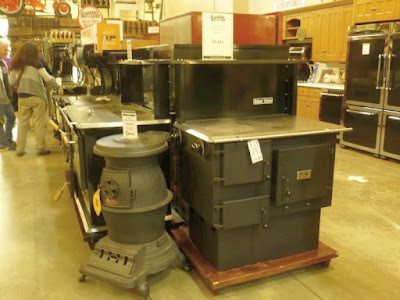
(This is our old antique parlor stove. We love it, but we have to admit it can't hold a candle to the cookstove for airtight efficiency.)
With the cookstove, we nearly got smoked out once or twice in the beginning until we learned which dampers to open, and when; but ever since then, we haven't had any problems. The performance of the stove (at least, in our case) is partially dependent on weather. The stove pipe draws better in breezy or windy conditions; during thermal inversions (which sometimes accompany dead-calm days), the stove doesn't draw as well, but we can make up for it by adjusting the dampers accordingly. (Incidentally, if our stovepipe were higher, i.e. over the roof line, these problems would probably be reduced.)
One of the biggest advantages is being able to come down to a warm house in the morning. Prior to this with our old parlor stove and especially during cold snaps, it was not unusual for the house to drop to 50F in the morning, and no matter how much wood we stoked it with, it took hours to warm the house up (and seldom much higher than 60F; we're all used to a cool house).
But now, the stove keeps the downstairs very comfortable, sometimes even
too warm (since, as I said, we're all used to a cool house). I no longer have to start a fire from scratch every morning. Instead, all I do is crack open the ash cleanout door (for added venting), add a couple of logs, and let the stove do its job.
At night, Don screws closed the back damper knob and leaves the front knob a bit loose. This closes down the air flow sufficiently that the logs inside simmer all night, burning very slowly and releasing heat evenly over many hours.
On the rare occasions we're all away from home, we do the same thing; it's pleasant to come home to a warm house instead of a cold one.
Because of the stove's sheer efficiency, we estimate we're using 1/2 to 1/3 of the wood we used before. This is a tremendous savings of time, energy, and expense. Imagine cutting your heating bill to 1/3 of what it is now, and you'll understand how tickled we are.
Since we're also using the stove for cooking, our propane usage has also decreased significantly. Twice Don has gone out to check the propane tanks to see if we need to call the gas company to refill them; and twice he's come back, shaking his head and smiling with pleasure, and noting we don't have to call them yet.
One thing we've had to learn is to "time" things differently. Take the kettle, for instance. Usually at night I'll fill it and put it on the warming shelf.
This way in the morning, the water is warmer than room temperature and takes less time to heat to boiling.
I get up early and like to have two mugs of tea, spaced a couple hours apart. I'll open the damper and get the fire going hot, heat the water to boiling, and pour my tea. Then I'll close the damper and put the kettle back on the stove, on the cooler side, to keep warm until I'm ready to re-boil it for my second cup.
If we have guests over but I don't need hot water right away -- say, for our weekly potluck, when coffee is served with dessert -- I put the kettle on early and let it slowly heat up until people are ready for coffee. If I need hot water quicker, I open the damper, fire up the logs, and the kettle will heat just about as quickly as it does on the propane stove.
Cooking is not a problem. I simply treat the stove top as, well, a stove top.
What's nice about a cookstove is since there aren't any "burners," I can crowd many things together.
Things that need to cook more slowly simply get moved to the cooler side of the stove. If something is cooked but needs to stay warm, I put it on the warming shelf.
Baking is a bit more challenging, in part because this model of stove has a small oven.
To bake, I push this back lever in, which reroutes hot air to circulate around the oven box before going up the flue.
While the oven has a thermometer, I don't pay it any attention. I simply keep an eye on whatever is baking. I thought I would have to rotate the food -- since the fire is one one side of the stove box -- but since the heat circulates around the box so evenly, I've found this to be unnecessary.
I have, however, burned things when I let the fire get too hot. It's not an exact science, and I'm still learning the details. However pies and such come out beautifully brown, far nicer than my propane range.
However, times when I need to bake larger volumes of food than the cookstove will hold, I still use the propane range.
We purchased the water reservoir for this model, but have not used it.
One thing we've learned to watch is to not get the fire roaring too hot and too fast. A couple of times we've had what is essentially a chimney fire, where the creosote in the pipe presumably catches fire and sends sparks shooting out the stove cap. We are also careful about cleaning out the pipe about every six weeks.
About every three or four days, we empty the ash tray. This is a simple matter of removing the tray (which has a handle at one end and no lip at the other end) and tipping the ash into a metal bucket. Takes about one minute.
So is there a downside to this stove? Yes. The biggest flaw we've found is the firebrick cracks too easily. They're not really bricks; they appear to be refractory cement which has been cast and shaped. It's more fragile than brick would be.
The cookstove has two possible ways to load the firebox: through the top (by lifting aside one of the round lids), or through the side (apparently only available in the Baker's Choice model). Since we're used to years of loading a woodstove through a side door, we continued to do so with the cookstove.
This means logs sometimes get slammed into the back wall of the stove, hitting the firebrick pretty hard. It's not surprising the back brick cracked in fairly short order.
Because the bricks that came with the stove are specially cut (or cast) to fit the stove, we couldn't just slip in a new firebrick; they have to be special-ordered. Ordering replacement bricks is not only expensive, but people have said the bricks often arrive cracked. They are, after all, quite brittle.
So we looked for alternative ways to repair the crack, and Don came up with the idea of getting refractory cement in a tube.
This comes in goo form, so we let the fire go out, cleaned out the stove, and then Don pushed the goo into the crack. Then we lit a fire to "cure" the goo. We did that about two weeks ago, and so far it's holding up beautifully (and we're trying to be careful not to "slam" logs into the stove).
This stove's efficiency is hard to improve upon. In fact, if you're in the market for a cookstove, I might go so far as to recommend foregoing the prettier or more elaborate antique-style stoves and opt for one of these air-tight stoves (there are three in the line: smallest is Baker's Choice, followed by Pioneer Maid, then Pioneer Princess).
So that's the skinny on our cookstove so far. I'm pleased to report it has exceeded all our expectations and is a wonderful addition to our homestead.