A task we've been wanting to accomplish since getting the cows is to subdivide the larger pasture. With fairly small acreage compared to our last place, it's important that we don't let anything get overgrazed, and having subdivided pastures allows us to rotate the animals frequently.
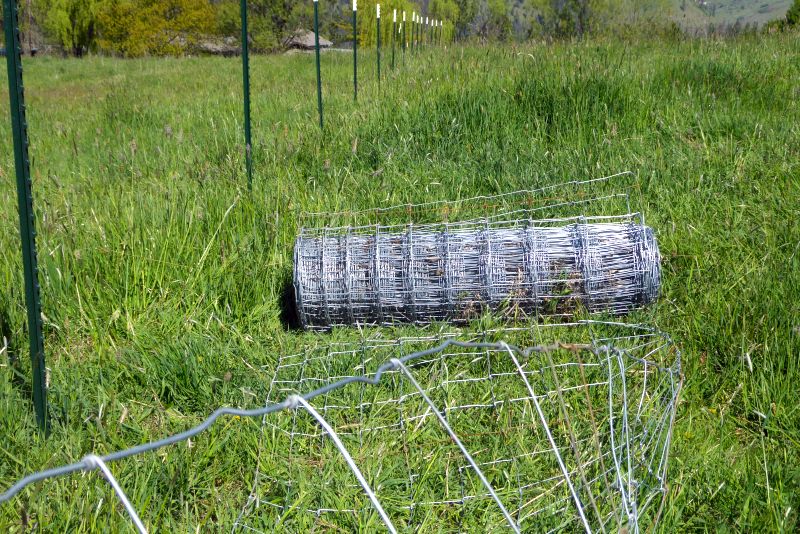
With that in mind, we gathered everything we needed. Thankfully we weren't faced with anything nearly as complex and difficult as fencing in the sacrifice pasture. In fact, we could bring all the heavy items (T-posts, roll of fencing, pounders, etc.) in the bucket of the tractor.
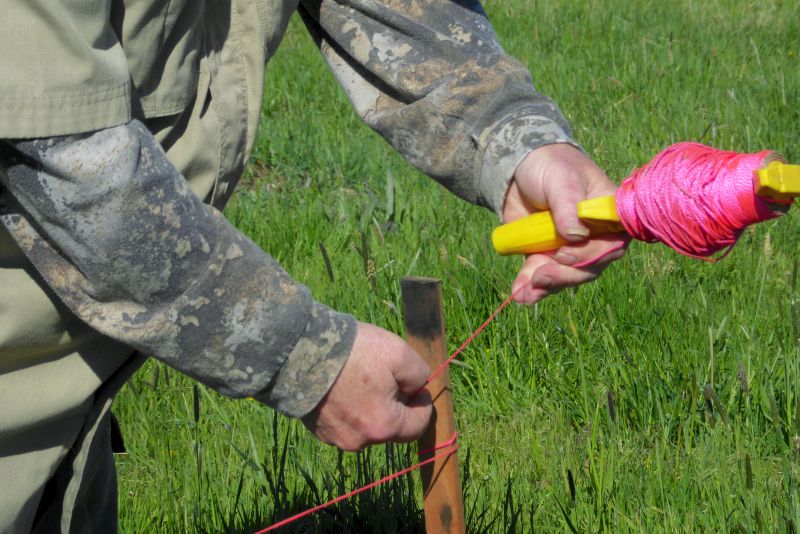
We unloaded everything and got ready to run a string.
Because the pasture is sloped (everything on our property is sloped!), we hammered a stake just where the line of vision breaks between one end of the fence line and the other. Then we used the bright-pink string to mark the fence line.
(There's my handsome man on his iron steed!)
Then we dropped T-posts at 12-foot intervals and started pounding. The
ground is still fairly soft, so it wasn't overly hard work. Don started
at the top of the pasture, and I started at the bottom, the idea being to meet in the middle.
There was only one problem with this task: There's a ridge line of rock right where the fence line was passing through.
Don was frustrated by this impediment and started theorizing about building field-fence cages filled with rock to make gabions, which would be an enormous task. "Why not just make a jog in the fence line and go around the rocks?" I asked. Don laughed and said it goes against his thinking. "Men think linearly," he said, and admitted going around the outcrop hadn't even occurred to him.
So we jogged around the rocks. I did the T-post pounding in this section, and sometimes I had to reposition the posts irregularly whenever I hit a rock, but over all it wasn't bad. (You can see the still-unfenced garden in the center-left of the photo.)
Pounding that many T-posts was enough work for a couple of senior citizens for one day. The next day we commenced stretching the fencing. For obvious reasons we started at the top of the slope and worked downhill.
We unrolled the fencing until we got to the jog around the rock outcrop, and cut it. (Don pounded and wired some older and somewhat bent T-posts to the corners of the jog to make "king posts" for extra support. No photos, sorry.)
With the fencing unrolled, we needed to stretch it tight. We started by threading a metal bar through the fencing...
...and attached the bar to a chain. The bar threaded through the field fence allows us to impost more or less equal pressure on the entire stretch of fencing at the same time, without deforming individual squares of the field fence.
Then he attached the chain to the fence-puller, one of those extremely handy homestead tools.
The fence-puller straddles the gap between the fencing and an upright support (a T-post, in this case). By ratcheting the fence-puller, the fencing material is stretched until it's tight enough to wire the fencing in place to the T-posts all up the line.
Once the fencing was pulled tight, Don and I started wiring the fencing to the T-posts.
We fenced the jog as well, though we didn't use the fence-puller in this section for the task of pulling the fence tight.
This completed the bulk of the project. We still have some ancillary tasks (notably building strategically placed gates), but this subdivision should serve us well as we endeavor to rotate the cows through the summer grazing months.
(Bonus photos: Here's a rose bush we thankfully didn't have to work through when installing the fence.
Look at those horrible vicious thorns. Now you know why I postulated these were the thorns that surrounded Sleeping Beauty's castle.)