Showing posts with label Lehman's. Show all posts

Monday, August 8, 2022

Product review: "Superb" canning lids

In June, I asked my contact at Lehman's (Glenda Lehman Ervin, Director of Marketing) for a supply-chain update, which she provided.

I was especially interested in one thing she mentioned: their bulk canning lids are back.

Among canners, Lehman's is famous for their bulk canning lids – hundreds of lids for a fraction of the price of conventional boxes of a dozen lids you find at the grocery store. Many years ago I bypassed the need for disposable lids by purchasing a lifetime supply of Tattlers, but there are still times I like using disposable lids. Yet I had never ordered a bulk supply from Lehman's (something I regretted), and for a while it seemed I had missed that window of opportunity.

This is why I was delighted to note their bulk lids are back in stock, though this time from a different producer.

"We have a new canning lid supplier (Superb – made locally just a few miles from the store), which is helping with the canning lid back orders," Glenda wrote. "Customers tell us they really like the lids, which are thicker and work well for high pressure canning."

I asked if I could test-drive a few of the lids for purposes of writing a review, and within a few days a dozen arrived in the mail.

The very first thing that's noticeable about these lids is the bright-blue gasket. The second thing is they are indeed thicker and feel heftier. The quality seems excellent. I mean seriously excellent – better than Ball lids.

Here's a lid edge-on.

And here's a "Superb" lid compared to a Ball lid. The gasket is noticeable thicker.

I tackled a double canning project early this morning, before the day got too hot. I wanted to test the lids with a water-bath project as well as a pressure-canning project. I decided on applesauce for the former, and green beans for the latter (splitting the 12 lids between the two projects). Because it's too early in the season for either of these available from the garden, I purchased apples from the store...

...and frozen cut green beans.

I started by dumping the beans in hot water to defrost them.

My canning book recommends hot-packing beans...

...so I brought them to a boil.

While the pot was heating, I started processing the apples.

I tossed the chunks in a pot of cold water with a bit of lemon juice, to keep them from browning while I finished peeling and cutting everything.

Once everything was peeled and cut, I drained most (but not all) of the water, and put the pot on the stove. For applesauce, the apple chunks need to be "steamed" into softness. (I covered the pot with a lid.)

While the apples were steaming, I went back to the green beans, which by this point were hot. I filled six jars with beans and added a half-teaspoon of salt to each.

Then I topped the jars with hot cookwater.

Then, because I had more beans than test lids, I filled five more jars and just used regular Ball lids.

Soon everything was ready for the canner. 

(I paused to add a thin layer of petroleum jelly to the rim of the canner lid. This is recommended every few uses.)

I capped the canner and brought the pressure up to 15 lbs. and let it process for 20 minutes.

While the canner was coming up to pressure, I turned my attention back to the apples, which by this point were fully steamed and soft.

Using a slotted spoon, I scooped the soft apple chunks into a blender, a bit at a time.
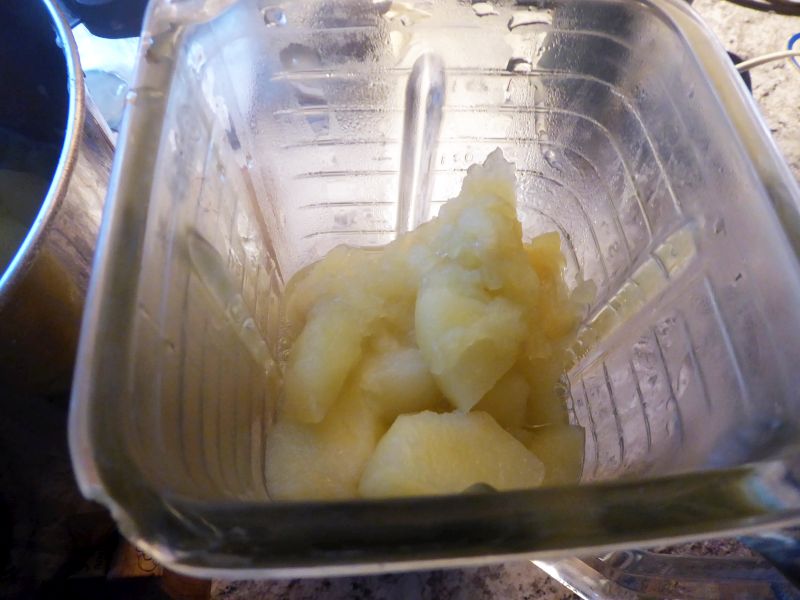
A few seconds whizzing the apple chunks around, and the result was a silky-smooth applesauce I could pour directly into the jars for processing.

At this point some people like to add stuff to the applesauce – sweeteners or cinnamon or even red-hots (candy). I prefer my applesauce to be plain and unsweetened, so it was a simple matter to just pour the sauce into the jars and cap them. I only had enough applesauce to fill four jars, which meant I had two lids left over.

Into the pot of water (notice the rack at the bottom – never can anything without a rack!).

I covered the pot and turned up the heat. I couldn't start timing until the water was at a rolling boil.

At this point the stove was full – pressure canner on the left, water bath on the right.

When the water bath was at a rolling boil, I started the timer.

After all that prep work, both the beans and the applesauce finished up almost exactly at the same time. I turned off the heat on both. I let the jars of applesauce sit for a few minutes in the hot water before pulling them out (this helps keep the contents from bubbling up and overflowing the jars). The pressure canner, of course, had to come down to "zero" pressure before I could open it.

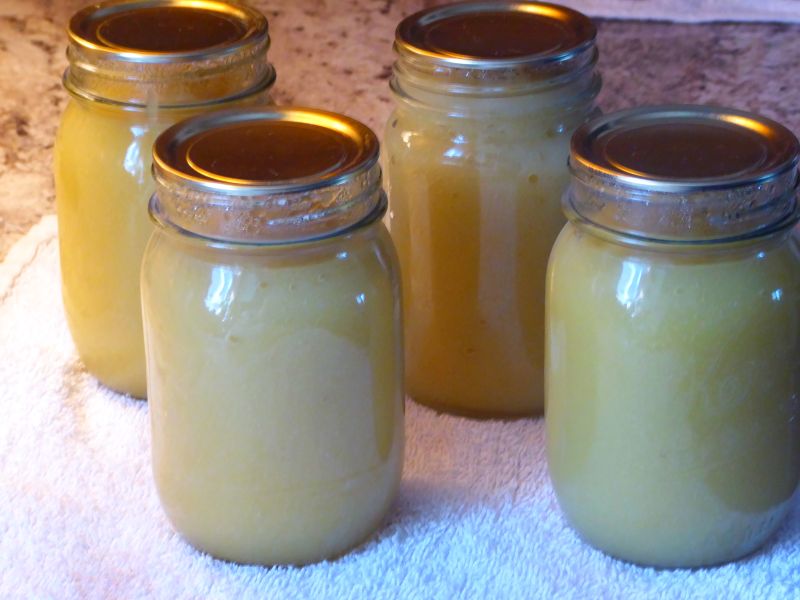
I pulled the jars of applesauce out and was mildly distressed to see the lids had not yet sealed. Oh great. I put the jars on a towel and waited. And waited. And waited.

Then...THUNK. One after the other, they all "popped" and sealed. Interestingly, the "pop" was in a base tone, not a treble tone – a much deeper sound than a standard lid. As Don joked, "They have manly pops, not girly pops." I expect the short delay in sealing was due to the thicker nature of the lids.
When the pressure came down on the beans, I pulled them from the canner and the same thing happened – a short delay, then one by one they all popped in and sealed.

I'm extremely pleased with the quality of these lids, and can recommend them without hesitation. What I can recommend even more is the price.

I picked up a couple boxes of regular-mouth Kerr lids at our local grocery store last February. They cost $4.69/box of 12 lids, or $0.39/lid.

However Superb (regular-mouth) lids from Lehman's are much more economical: $19.99 for a pack of 60 ($0.33 each), or $84.99 for a back of 360 lids ($0.23 each). (The wide-mouth lids are $84.99 for a pack of 300, or $0.28/each.)

If anyone is in the market for bulk quantities of high-quality canning lids, this is the deal for you.

In fact, both the price and the quality are hard to resist. I think I'll place an order myself. After all, I don't want to miss that window of opportunity again.

Thursday, June 23, 2022

Supply-chain update

Recently, I asked my contact at Lehman's the following: "When you have a moment, I'd love to hear your take on supply-chain issues and what kinds of products are in short supply."

Glenda Lehman Ervin is the Director of Marketing for Lehman's, and she wrote the following:

"I talked to merchandising and they said vendors are ramping up production and demand is softening slightly, so supply chain issues are still there but are loosening up. The biggest issue we have is with the Pioneer Princess wood cook stoves – we are still taking (and getting) orders, but we are at least a year out in filling those orders."

"We have a new canning lid supplier (Superb – made locally just a few miles from the store), which is helping with the canning lid back orders. Customers tell us they really like the lids, which are thicker and work well for high pressure canning."

"Lodge has made investments into production and plans to add back the SKUs that were discontinued (so they could focus on the most popular SKUs during the height of big demand). We do see spikes in back orders for seasonal items (for example, outdoor games and seeds when summer hit) but for the most part, we are keeping up."

So there you go, folks. The latest from a large retailer whose products are in high demand.

Tuesday, September 14, 2021

Need a pressure canner?

I just heard from Glenda Ervin, Director of Marketing at Lehman's, that they have All American canners (Model 921) again. Specifically she said, "We have hundreds of these canners in stock (finally)!"

This is the exact model I've had for over 30 years. It's a phenomenal beast designed to last a lifetime. If you're looking for a pressure canner, I can't recommend this model highly enough.

I literally taught myself how to can back in 1991 by following the directions in this canner's information booklet (which I still have). I have canned untold thousands – possibly tens of thousands – of jars of food in this canner over the last three decades.

Additionally, Glenda said they found a new supplier for bulk canning lids.

Just passing along the word. If you want a canner, I wouldn't delay if I were you.

Wednesday, August 4, 2021

Need canning lids?

I just got a notification from Lehman's that they have canning lids in stock.

When I checked the link (click here), they still had supplies. But the ad also stated "First come, first served." If you need canning lids, better move on it.

 
UPDATE: Apparently the lids are already sold out and on back order. Holy cow, that was quick.

Tuesday, March 23, 2021

Canning supplies: Still a problem

Once in a while I dip into the issue of canning supply shortages, wondering what the status is. I've noticed there seems to be some canning jars in local grocery stores again, though lids still seem to be missing. But what's going on in the wider world?

So this morning I got onto the Lehman's website (which is kind of my "indicator" source) to see what's up. Looks like supplies are still sold out. Here's the announcement for regular-mouth canning jars:

Underneath the entry is the note: "Due to high demand, the vendor has been sending supply of styles that vary. We are sorry for the inconvenience, but we cannot guarantee a particular style."

Same thing for all jar sizes, such as wide-mouth quart.

Canning lids, of course, are completely gone. I've always kicked myself for not getting a few shipments of bulk lids when they were available. Despite mostly using Tattlers, I like having disposable lids as well.

Lehmans has been hammering at the doors of their suppliers, to no avail:

Reusable lids still seem to be in stock, which was nice to see (although the reviews indicate some people aren't familiar with how to use them).

Next, I checked pressure canners. As you might have guessed, none are available. Here's a mid-range All-American canner:

(A quick check on the All American Canner website confirms the lack of availability.)

I checked in with Glenda Lehman Ervin, VP of Marketing, to get her take on the situation. She wrote back and said:

"Yes, canning supplies are very difficult to get, as are certain Lodge cast iron products, wood cook stoves and Berkey water filters.

We do have stock of canned meat now, as well as Aladdin lamp oil and several key gardening products, which were back ordered.

Each week we get lots of product in, but it turns right around as we fill back orders and supply pent-up demand.

We ask customers to please be patient – we are working on increasing our communication on the status of back orders.  We do recommend placing an order to reserve your place in line!"

This is an immensely frustrating situation for retailers. Remember, they can't sell what they can't get.

What has been your experiences, dear readers? Do you have any suggestions for those looking for canning supplies?

Thursday, March 4, 2021

Power outages then and now

Like much of America, we had a blast of winter during February.


Before the winter blast, we took advantage of freezing temperatures to move the enormous box truck up the barn driveway (there are separate driveways leading to the house and the barn). This is the separate driveway, if you recall, where we got the U-Haul stuck in the mud when we first moved in. It is still an impassible morass of mud, which is why we had to wait until the temperatures froze it solid to get the truck up there. (We'll get some gravel on it when spring comes.) Prior to this, the box truck was in the house driveway. Now the truck is in a more convenient location to unload it when the weather cooperates.

The snow moved in. Gradually our car disappeared.

We learned there are lots of guys living in the neighborhood who use a snowfall as an excuse to bring out their heavy equipment. Since we're temporarily without our own heavy equipment (the tractor is still at our old place), we were grateful. Don went out to thank this fellow for clearing a portion of our driveway.


We watched a neighbor's vehicle across the way from us, which got stuck. His driveway is both steep and long, not something I'd want to tackle in adverse conditions.

Clearly he spun around quite a bit, trying to get traction, before abandoning the truck and walking home.

Later we saw him try again to drive uphill, but after sliding sideways downhill, he gave up, backed the truck to the base of his driveway, and waited for better conditions.

Unlike at our old place, we have to make adaptations for handling winter here. That's because we learned snow usually equals power outages.

Water isn't a problem. We have enough stored for several days of careful use.


 Lights aren't a problem. We have plenty of lamps and kerosene.

The problem is heat. As the folks in Texas brutally learned, electric heat sources are terrible things to depend on, yet that's all we have in our new home (pellet stove and forced-air heating), at least for the time being. Our brand-new wood cookstove still sits in the barn at our old home, and boy howdy we can't wait to get it installed.

But after the first power outage of the winter, we had to scramble to stay warm. Fortunately Don had purchased a Mr. Heater portable Big Buddy propane heater, suitable for indoor use. He got it several months ago for emergency use in our temporary rental home. We never needed it there, but we were sure glad we had it here.

He hooked it to a propane tank. Had we required it (and we didn't), this tank would have lasted about 20 hours at the lowest setting. We had another tank on standby.

I won't say this little heater kept the house spectacularly warm we topped out at 60F but it was certainly better than nothing. It's only rated to heat about 490 square feet, so it had its limitations.

We parked the bird cage right in front of the heater to keep Lihn as comfortable as possible.

In this case, the power wasn't out for more than 12 hours, so we were fine. We even got a bit of sunshine, which was a nice change, though it didn't do much to heat up the cold weather.

This is the challenge here in our new home: Finding reliable, low-tech, non-electric sources for the necessities of heat and water. We'll document how we tackle these things as time goes by. Stay tuned.

Update: A reader left a comment as follows: "Hi Patrice, I appreciate your blog and have been a reader for years. I live in Western Oregon and have some (not enough) preps in place. So when the recent ice storm was forecast here I was feeling a little smug and unconcerned. However I was away for about 10 days in another state helping a family member when the storm came and the power went out. My adult daughter was home. I had advised her to fill the bathtub with water and get some containers of drinking water together which she disregarded. We have a wood stove and stored food and several oil lamps so I thought we would be ok for a few days. It turned into 6 days. When we finally came home it was to a cold, damp house and no water and were still without power. My hubs and I rallied and went to a friend's house and got about 10 gallons of water to get us through the night and fired up the wood stove and began collecting rain water in a stock tank we keep around specific to the purpose. (rain is a fair bet around here) We are able to cook on the woodstove and have a campstove that we pulled out. MY failures were many and we are beginning to think of how to address them but in the short term not having adequate lighting was tough. I have several oil lamps but they are so dim I felt nervous getting them close enough to read by worried I might accidentally knock them over. I know you've gone over this before but I couldn't find the info. Would you consider summarizing your experiences with grid down lighting please and thank you? Soggy in Salem"

I don't claim to be an expert in grid-down lighting, but for what it's worth, here's my two cents.

I happen to love kerosene lamps. They're our go-to option when the lights go out. However "Soggy in Salem" is correct they're very dim. In pre-electric days, people just accepted the fact that most lighting options were dim, and that was that. But people have gotten used to brighter illumination, which brings challenges in grid-down situations.

A brighter alternative to kerosene lamps is Aladdin lamps, which are essentially kerosene lamps with a mantle (similar to Coleman camp lantern which also use mantles). These put out a tremendous amount of light something on the order of 60 watts for each lamp. The downside is they're on the pricey side, and mantles can be fussy. Aladdins used to be available nearly everywhere I remember buying our lamps at a local hardware store back in 1998 or so but my understanding is the only remaining distributor is Lehman's in Ohio. They not only have a small in-store museum dedicated to Aladdins, but they have every possible permutation of the lamps, along with every possible replacement part.

Nowadays, there are all sorts of battery, solar, and LED lights available on the market. My recommendation is to contact the customer support personnel at Lehman's, which has a massive off-grid lighting department, and discuss alternatives with them. Their sales staff is trained and knowledgeable, and I can't imagine a better resource anywhere in the country who could offer better advice.