Showing posts with label nature. Show all posts

Thursday, October 9, 2025

Vultures as archeologists

I saw two back-to-back articles (here and here, with the original paper published here) on the subject of bearded vulture nests being used as a source of archeological treasures. Fascinating.

It seems bearded vultures, an Old World species, have nests that go back generations. Some of these nests, in fact, go back centuries. Biologists are learning that sometimes, over the course of time, the vultures have incorporated things in the construction or reinforcement of their nests that are of archeological interest. As a result, scientists have started examining these nests with a closer eye.

In northern Spain, archeologists found over 200 human artifacts, including a  650-year-old sandal made from woven twigs and grasses. Other finds include bits of rope, a crossbow bolt with a wooden lance, a slingshot, and bits of leather. How cool is that?

For obvious reasons, the scientists are only examining nests that are no longer in use, since they must tease them apart layer by layer. Since the vultures often nest in cliff caves, the cool, dry microclimates have proven to be perfect for preserving artifacts for centuries.

Nature is amazing.

Thursday, February 24, 2022

Cat vs. magpies vs. vole

Early one morning, Don looked out our kitchen window and saw one of the neighbor's cats in our pasture.

This is nothing unusual, as the pasture appears to be rich hunting grounds for the cats. Frankly they're welcome to take all the mice they want.

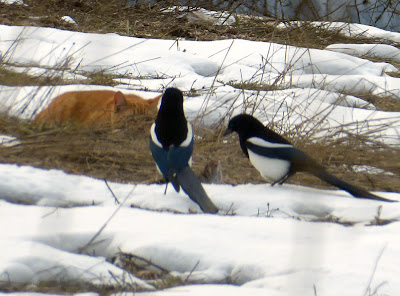
But what caught Don's attention wasn't the cat per se, but the proximity of the cat to a pair of magpies (only one of which I could capture in the same frame as the cat).

"Look how close together they are," he commented. We watched as the mapgies stalked around the disgruntled-looking cat.

But soon it became apparent there was more to this little drama than met the eye.

Can you see what the magpie sees?

Let me enlarge it for you.

That's a vole on the left, right in front of the magpie.

Sadly the vole knew exactly what lay in store for it. There was no escaping the magpie's beak; and if there was, the cat was right there to finish it off.

Meanwhile, look at the cat's expression. We missed the opening scenes of this drama, but we speculate it's the cat who flushed out the vole, and then the magpies took over. The cat wisely knew it would be dangerous to try and attack the magpies, and he looks very annoyed that his breakfast was stolen.

I don't know if the vole was injured by this point, but it hardly mattered. It was doomed. Magpies are vicious killers.

Here's the second magpie, moving in for the kill.

A direct attack on the vole wasn't long in coming.

At this point the vole (located between the two magpies) was still alive.

But the magpies kept flipping it around, doubtless injuring it more with each flip.

I felt very sorry for the vole, let me tell you.

It was hard to tell, but it seemed this was the killer blow.

Victory dance?

With the vole dead, it was never clear if or how the magpies shared the feast. I suspect there was no sharing. Magpies don't have that much altruism in their shrunken little hearts.

After the magpies had departed with their loot, the cat hung around a bit longer, no doubt hoping for another vole to show up.

Interestingly, long after the cat had departed, we noticed a lot of magpies hanging around the same general vicinity. Must be a lot of voles up there.

Just a little slice of life in north Idaho. Or in the case of the vole, a slice of death. Ain't nature grand?

Wednesday, May 15, 2019

Can you see the stars?

Last month, an article came out indicating only 1 in 50 people can see the stars "as Nature intended" due to light pollution. The article focused on the population in the U.K., a smaller and more crowded place than the U.S.


But America has more than its share of star blindness. Many years ago I visited Chicago, and one of my most distinct memories of that huge city is what the night sky looked like. Nothing was visible -- not a single star -- and the only celestial body I could see was the moon. The rest of the sky was blackish-orange from the glow of the streetlights.


Sadly, many people simply don't know what they're missing in the night sky.

As an example, consider what happened after the devastating 1994 Northridge earthquake, which knocked out power in and around Los Angeles. The quake struck during the pre-dawn hours, and people went pouring out into the streets -- only to freak at the frightening "giant silvery cloud" overhead.


Calls poured into various emergency centers, with residents being assured they were merely seeing the Milky Way (evidently for the first time).

According to this article, "More than 80 percent of the world and more than 99 percent of the U.S. and European populations live under light-polluted skies. And according to the world atlas of artificial sky luminance, the Milky Way is hidden from more than one-third of humankind, including 60 percent of Europeans and nearly 80 percent of North Americans."

(Translation: 80 percent of North Americans are urban.)

In an effort to reclaim the night sky, a group called the Dark Sky Association is working with some cities to implement lighting systems that cast lights downward only, rather than everywhere. I sincerely hope it helps.

Ironically, the rapid spread of energy-efficient LED lighting is resulting in more light pollution, not less. The earth's artificially lit outdoor area is growing by 2.2 percent per year, with a total radiance growth of 1.8 percent per year. Why? Because they're so cheap and energy efficient, buildings are being encrusted with LED screens and lights when they weren't before, resulting in far more light pollution.


Can you see the stars where you live? I hope so, because there's no better testimony to Psalm 19:1: "The heavens declare the glory of God; the skies proclaim the work of his hands."

Wednesday, April 20, 2016

At this rate I'm gonna live forever

The Washington Post had an article today entitled Why living around nature could make you live longer.

It seems a new study came out of the journal Environmental Health Perspectives which found "people who live in 'greener' areas, with more vegetation around, have a lower risk of mortality."


The methodology for this study seems a bit odd, however:

The research relied on data from a vast long-term Harvard study funded by the National Institutes of Health called the Nurses’ Health Study, which has collected health information biennially on more than 100,000 female registered nurses in the U.S. since 1976. The new paper analyzed participant data from between 2000 and 2008, taking note of any deaths that occurred and their causes. At the same time, the researchers used satellite data to assess the amount of green vegetation surrounding each participant’s home during the study period.

(Did they ever talk to homesteaders? Organic farmers? Nursery workers? Anyone else who works outdoors in rural areas?)


The article continues:

This is all in line with the ways previous research has suggested greenness can affect health. Places with more vegetation are generally thought to be less polluted, and the presence of vegetation, itself, can help keep air cleaner. And green spaces like parks can help encourage people to get outside, exercise and engage with other people — all factors that can improve overall health. The effects on mental health may be somewhat less straightforward, but nonetheless important, as this study suggested.

What, you mean being surrounded by huge buildings and endless acres of concrete and air pollution and traffic and constant tension isn't good for you? Who'da thunk?


“We were really surprised to find that the mental health pathway explained about 30 percent of the relationship between greenness and mortality,” said Peter James, the study’s lead author and a research associate at the Harvard T.H. Chan School of Public Health.

He's right. Half the benefits of rural life is being able to decompress by stepping outside.


Still, much remains uncertain about the exact mechanisms by which exposure to nature can improve health, Frumkin noted. And scientists are still trying to figure out what type of contact with nature works best.

“Is a it a view out the window or do you need to get out and walk among the trees?” Frumkin said. “Does a bush do the trick or do you need a tree? Does it need to be in leaf during the summer, or does it work during the winter when it’s lost its leaves? There are lots of questions about the mechanisms and specifically about what form of nature contact offers benefit.”


Well, one thing's for certain. At this rate, I'm gonna live forever.

Monday, February 9, 2009

Nature: Good, Bad, and Ugly

My girls and I drove to town yesterday. Half-way down our two-mile dirt road we stopped because we saw a dark shape move off the road into the woods. Turns out to be a yearling moose, probably female although at that age males probably don't have antler stubs. She was quite unafraid of us as we sat in the truck and looked at her from about twenty feet away. Huge, mule-like ears, comical face, altogether darling.

A neighbor said the yearling has been hanging around for the last couple of weeks. Moose calves don't leave their mother for about two years, so this one's mama probably got hit by the train that skirts our peninsula two or three times a day.

I'm fond of moose, and I hope this little girl makes it. Nature can be so damned cruel at times.

I've started bringing my camera with me when we go to town, and will try to snap a pic of her.