Showing posts with label water. Show all posts

Monday, November 25, 2024

Downpour and fill-up

We missed most of the dramatic bomb cyclone + atmospheric river that blasted the west coast over the last week. These storms did a massive amount of damage over the region, including multiple feet of snow in the mountains that snarled traffic and caused horrific accidents.

We can usually expect the residuals of such storms to hit our inland area within a day or two. To that end, we battened down the hatches and prepared to hunker down for the duration. The rain moved in late Friday night, after I'd gone to bed. We had hopes the newly installed roof-runoff water tank, then about one-third full, would top off. Don (who comes to bed later than I do) planned to let the gutters drain the initial roof runoff (to clean everything) for about half an hour, then divert the runoff into the tank before he came to bed.

Thankfully we had no wind, but it rained and rained and RAINED and rained the blessed night long. Early Saturday morning before dawn, I laid in bed, listening to the pounding on the roof, and thanked God the livestock were snug and dry in the barn.

Or so I thought. When I went out to feed them, this is what I saw:

Well, no one ever said cows were bred for brains, as I always say. To be fair, by the mess left in the barn, it seemed their jaunt into the weather was fairly recent and they had, in fact, spent the night under cover.

I cleaned the barn, and while I dumped the night's leavings on the compost pile, the animals moved back inside.

Once the feeders were full, they all settled in to enjoy breakfast.

Even before attending to the cows, just after I got up (around 5 am, so still dark), I took a flashlight and peered over the edge of the balcony, where the outflow pipes from the water tank were just visible. I saw water flowing out of the pipes, which could mean only one thing: The tank was full to overflowing. Accordingly, I flipped the levers to divert the roof runoff from the tank back to the downspouts. Later I photographed the edges of the overflow pipes, no longer running:

This was the first opportunity to test these outflow pipes, and they worked beautifully.


Later, I lifted the floor hatch on the deck and unscrewed the access hatch on top of the tank. Sure enough, brim-full. Those are the outflow pipes, at the top-right.

Fifteen hundred gallons of water!

Even better, this is a passive and inexhaustible source. This much water will get us through long dry spells, providing both household and livestock water. And every time it rains, we can top off the tank.

Now that the tank is full, we'll add chlorine to keep it pure. We still have no plans to drink it directly from the tank until filtered (or boiled), but the peace of mind that comes with abundant water is impossible to underscore.

Monday, October 28, 2024

Water project ... done!

A couple months ago, after Don finished a large project (the new woodshed), I remember he came inside, sat down, and asked, "What should I work on next?"

There is never a shortage of projects, of course, and he could have gone in any number of directions. But I had an instant reply: "The water tank."

Let me back up. Since moving rural in 1993, we've never had a secure source of water. What I mean by this is our wells have always had electric pumps. During power outages, those pumps don't work and we have no water. We've compensated by storing water in anything from one-gallon jugs to 50-gallon barrels, but it's still a limited resource. Water (or a lack thereof) has always been my biggest rural insecurity.

Our last home was particularly challenging because our well was 610 feet deep (with a static water level of 450 feet), far beyond the capacity of hand pumps and far beyond our financial ability to construct a deep-well windmill or other options. (We compensated by building a pond.)

The well here in our new place is much more shallow, about 120 deep with a static water level of 40 feet. This puts it within reach of a hand pump. (In fact, we purchased a hand pump but haven't yet installed it because the well is inconveniently located inside a shed, which means we have to dismantle the shed before installing the pump. Yes, it's complicated.)

So, in the spirit of "three is two, two is one, one is none," we wanted to install a water tank fed by roof runoff as a backup source of water.

To this end, we purchased a water tank. There were a number of factors to consider in this decision: price, size, location, shipping, etc. After examining all possibilities, we selected a vendor in southern Idaho and purchased a 1500-gallon vertical above-ground tank which was on sale. Additionally – highly important – they could deliver.

So in April of 2023, they delivered the tank. We parked it next to the woodshed, covered up all the port holes (so critters wouldn't get inside), and there it sat for 15 months.

But we had a tank! It's hard to describe how excited I was by the prospect of a secure water source.

While Don worked on other projects and the water tank sat next to the woodshed, the Big Question was where we should put it. We had several options: Under the deck on the north side of the house; off the kitchen on the south side of the house; nearer to the garden; or even next to the barn (to supply the livestock).

After weighing the pros and cons of each location, we decided to place the tank under the deck on the north side of the house. The clearance was adequate, and this space wasn't being used for anything else anyway. Additionally, it's convenient for both fire suppression (a fire truck has the room to back up to the tank and hook into it) and livestock (the underside of the house is fenced off to keep the cows out, but it would be easy-peasey to put a water tank just outside the fence).

This decision was just the first step in a loooong process of installing the tank, beginning with cutting a level pad into the slope below the house

Don framed in the pad, then laid down weed cloth. Then he backfilled it with gravel (at the botton) and sand (on top) to provide a solid foundation for the tank that wouldn't have any sharp rocks that could poke a hole in it.

The next step was to move the tank from the driveway to the new pad below the house.

This was an exceptionally delicate procedure. We knew the tank had adequate clearance under the deck ... barely. The difficulty was getting the tractor to climb the slope below the deck, clear the lip of the pad, and place the tank in location without the tank bumping into the deck in the process.

It took slow and careful work to get the tank in place. It also showed Don's mastery of his machine.

That's the clearance between the top of the tank and the underside of the deck. Don had this engineered to the nth degree.

He was also forced to lay down hardware cloth around the tank over the sand...

...after some neighborhood cats started using it as a giant litter box.

With the tank in place, the hard work began. Don had to design and implement an entire customized plumbing system to direct roof runoff into the tank. This included intake valves, overflow valves, guttering, drain pipes, etc.

I'm glossing over weeks of work here, folks. I can't emphasize enough my clever husband's success in plumbing this monster in.

Mr. Darcy was always interested in the procedure.

But finally the bulk of the work was done. He had installed split downspouts in the gutters from both sides of the deck. By flipping a lever, water can either be diverted into the tank, or allowed to flow down the gutters.

He also installed filters that would sift out gravel and other debris before the water could enter the tank.

You can see how one of the gutter splits looks from this angle.


Plumber's tape supports the pipes on the underside of the deck.

What we lacked, at this point, was rain to test the system. Finally the weather predicted some incoming precipitation, and Don pushed through to finish everything before it came in.

This included cleaning out the gutters.

Because our roof is shingle, debris gets washed into the gutters (not to mention all kinds of other detritus). Here's a "before" photo...

..and the "after" pic.

The rain actually moved in before getting the hand pump installed. We let the rain wash the roof for about half an hour, then moved the levers to divert water into the tank. What a gratifying sound as the tank began to fill!

But we didn't know how much water we'd gotten. Don put together a chart that gave an estimate:

• Average yearly precipitation – 24.89 inches
• Highest ave month – 3.94 inches, May
• Lowest ave month – 0.87 inch, August
• Average monthly precipitation – 2 inches

Area served by gutters and downspouts to tank: 1,425 square feet.

1,425 sq ft x 1/12th of a square foot (1 inch of rain or .08333 feet ) over 1,425 sq ft = 118.8 cu ft = 888 gallons 

With a roof of such-and-such size and the amount of rain, we anticipated we got about 200 gallons from that one rainstorm.

But to access the water, he needed to install the hand pump. So he cut a hole in the deck to reach the access hatch on top of the tank.

He drilled a hole and sank a pipe next to the access hatch to plumb in the hand pump.

Don had ordered the hand pump several weeks earlier, so with the plumbing in place, he was able to install the pump itself.

He built a sturdy and permanent table heavily coated with a clear epoxy, and fastened the pump to the top.

A new pump must be primed to let the leathers soak before using it.

But then we were able to pump ... and it worked!

Sort of. As is typical of any plumbing project, stuff happens. Don found there was a leak from a valve at the bottom of the tank. So he opened the tank and flushed out as much water as he could.

Then he fixed the valve and we waited for the next rainstorm.  This came in a few days ago, and the valve is not leaking. Right now we estimate we have about 300 gallons in the tank ... far, far outstripping the amount of stored water we previously had on hand.

We're entering a wet period and anticipate we'll have the tank full to capacity within a month, after which we can switch the gutters back to divert water down the downspout, as before.

While we will add chlorine to the tank once it's full, we have no plans to drink the water directly from the tank without filtering (or boiling) it first. However the water has endless other uses during a power outage: Showering (using shower bags), washing dishes, flushing toilets, watering livestock, fire protection, etc.

The next step is to insulate the tank. We're planning on making an insulated wrap to keep things from freezing in winter. That will be a whole blog post unto itself.

The sense of security this new project gives us is impossible to underestimate! I've always keenly felt our vulnerability as far as water during an extended power outage. This tank cures that concern.

It also underscores the need to tackle such complicated projects sooner rather than later. While obtaining the tank almost a year and a half ago was a major step in the right direction, we didn't realize how many specialized parts would be needed to plumb it in. Don took many trips to the hardware store as well as ordered many parts online (including the hand pump) to complete the project.

Water project ... done!

Tuesday, October 18, 2022

Everything's fixed!

Well, after having what seemed like everything fall apart in the last couple of months, I'm pleased to report everything's fixed.

It all started in early September when our water heater went kaput.

Fortunately we had purchased a portable on-demand shower heater, so Don built an outdoor shower and we used this for most of September and October.

We ordered a replacement water heater, but its delivery was delayed for weeks.

During this waiting period, we had another project: Installing a larger propane tank. Last year we had a small tank installed, but larger tanks weren't available. This year, they were.

But getting this larger  tank was a whole ball of wax by itself. A large tank can't be installed against a structure; it needs to be placed away from the house, which meant digging a trench to bury the line.

This is the peaceful little side yard where the trench had to go, before all the chaos interrupted it.

In attempting to trench the ditch using a sub-soiler, Don inadvertently snapped the power line to the well pump, leaving us without any water whatsoever.

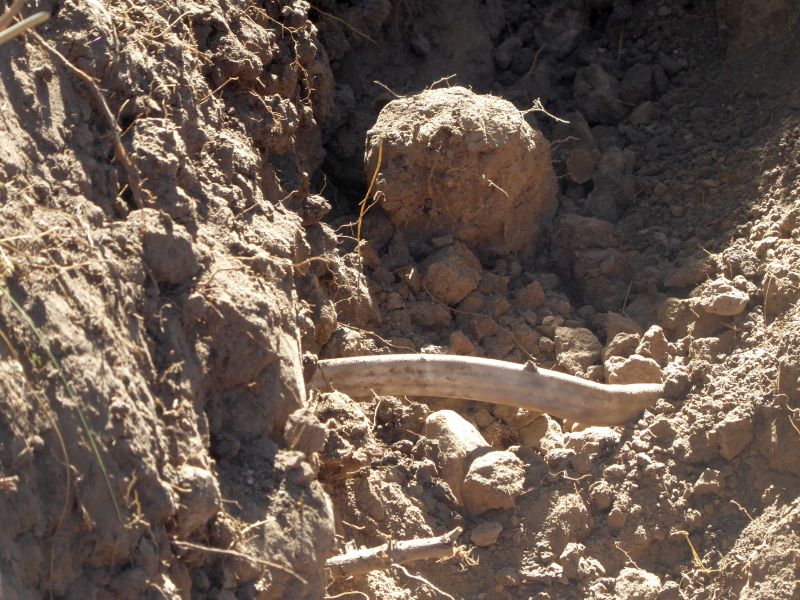
This led to yet another issue: the power line to the well, we learned, was not burial cable; it was standard household romex (the kind of wire that's supposed to be inside walls and safe from moisture). Who DID this? We have no idea how long this sub-par wire has been buried, much less how it managed to hold up to (presumably) decades of use. In the end we agreed it was a blessing in disguise that Don snapped the wire. Had that not happened, we would never have known where it was buried in the event of a future failure.

To fix the power line, a neighbor came in with his small backhoe and dug a trench from the power source to the well house, about 100 feet.

Then the proper burial wire was laid down, hooked up to the well, and the trench filled in. Took a few days, but at least we had (cold) water back.

But we were also on a deadline to get the trench dug for the propane tank. It sounds so simple, right? All we had to do was dig a trench four inches wide and twelve inches deep. One of the challenges was getting a hole underneath this concrete walkway. 

The trouble is, we're living on a bed of pure clay. Digging that trench was some of the hardest physical work we've ever done.

Don did what he could with the subsoiler, which at least broke up portions of the clay.

But after that, it was all hand work involving an enormous variety of tools: pick-axe, breaker bar, rock hammer, clamshells, Sawz-all, etc. The four-foot section between the walkway and the house alone took me hours, and mostly involved smashing the clay lose with the heavy breaker bar. (That's the old smaller tank on the right, that was being replaced.)

Once the trench was deep enough, we started hammering a pipe under the walkway using a sledgehammer, so the propane pipe could be installed. We'd hammer it in a couple inches at a time, then pull it out (using pipe wrenches), clear the dirt, and hammer it in some more. Repeat. Repeat. Repeat. Repeat. Repeat. Repeat. Repeat. Repeat. Repeat. Repeat. Repeat.

At long last, the tip of the pipe emerged from the other end.

Can you see it?

I spray-painted the opening to make it more visible for the propane installers.

Here are all the tools we used to dig that bloody trench.

When the trench was finished, we had a couple days before the propane tank installers came. The weather promised to be dry until literally the day they arrived. We were worried the trench would fill with water, so we covered it as best we could.


Those poor tank installers arrived during a torrential downpour.

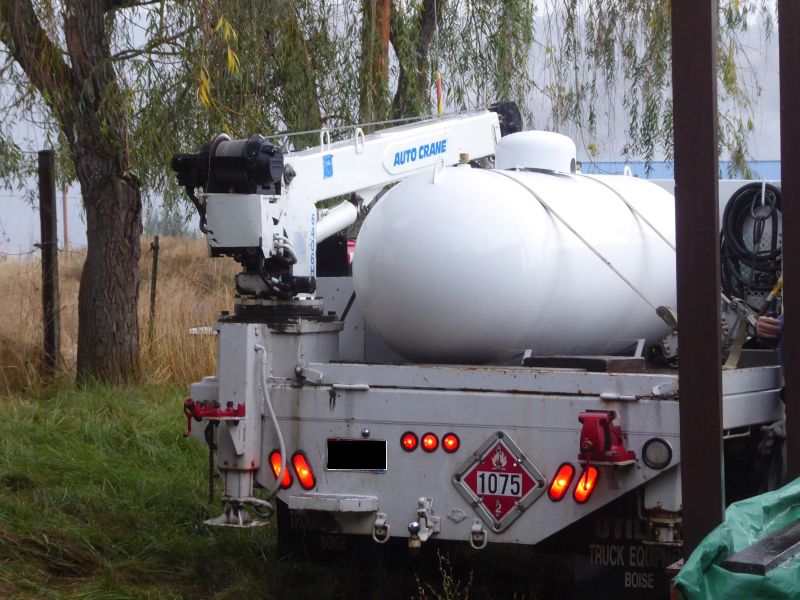
They did NOT waste any time, let me tell you. They swung the new tank onto the pad we'd made.

They leveled and braced it.

Then they removed the old, smaller tank...

...and placed it next to the larger tank just long enough to transfer the propane from one to the other.


Then they buttoned everything up and fled. The poor guys were soaked. I wished I had some warm cookies or something I could have offered.

About a week later (in much better weather), the propane company came out and topped off the tank.

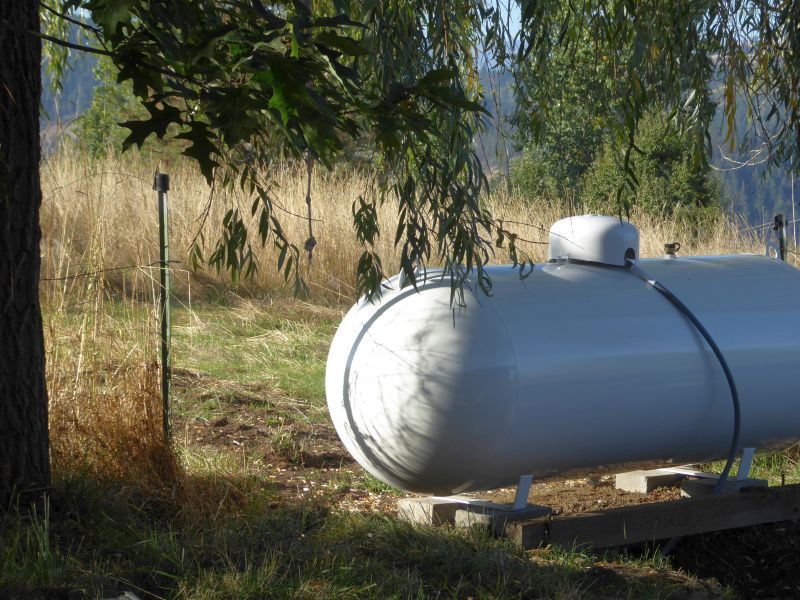
The view from the kitchen window is less picturesque now, but (I think) more beautiful. Having a large propane tank is such a nice secure feeling.

Meanwhile the new water tank finally arrived.

It promised to be a model of ease and efficiency. Famous last words, right?

I should point out the water heater itself is fine. It was everything else that went wrong. Don discovered a cascading series of plumbing catastrophes, mostly involving PEX hosing. He made more runs to the hardware store over the last four weeks than in the last two years.

The floor under the old heater had water damage. How long has that been there? Who knows?

The floor wasn't wet (at this point), so Don installed an OSB cover for extra strength.

Then the investigations began. He found a wet patch under the house, indicating something was leaking or dripping. He traced it to the dishwasher, an appliance we have literally never used since moving into the house nearly two years ago. Out it came.

Then he took a closer look under the kitchen sink and saw how badly it was plumbed. Honestly, who's responsible for all this? Not the people who sold us the house; they had only lived here three years.

I mean, look how the valves are embedded into the cabinets bottom. It's impossible to turn them.

The water leak under the dishwasher was pretty bad. And old.

We set a fan in front of it for about 12 hours.

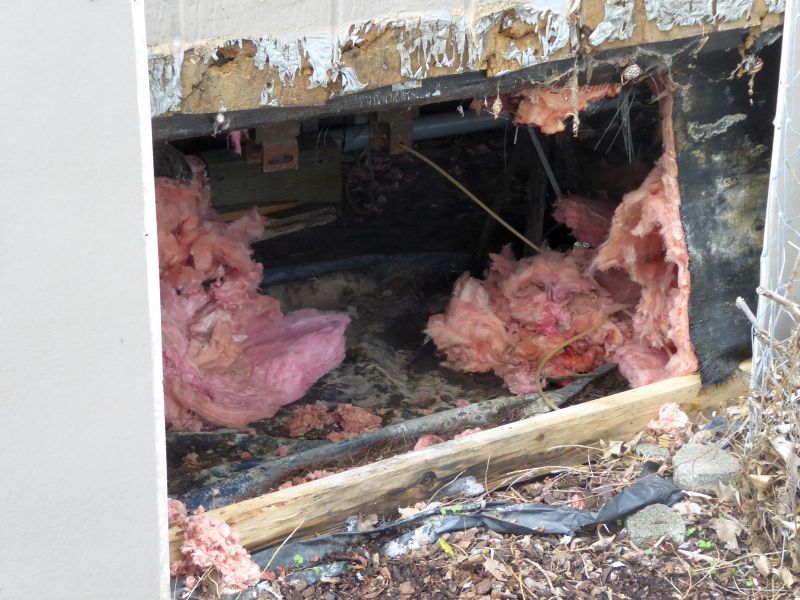
Meanwhile Don crawled around under the house, taking out sopping wet insulation and tracing other leaks.

It turns out it wasn't just the dishwasher hose that was leaking; it was the line to the refrigerator. Remember all the issues we had with the stupid fancy refrigerator? This is why we prefer simple appliances!

So, working backwards, Don corrected all the issues. He replaced all the kitchen hoses, put in new PEX lines, installed dry insulation, and stapled up new "belly fabric."

Then he purchased a brand-new sink faucet and installed it properly

That took care of the ancillary plumbing issues. However there was still the hot water tank to install. And oh my, I don't think I've ever seen my saintly husband so frustrated in the 32 years we've been married.

There were a number of issues he faced. The old tank was installed when PEX tubing was apparently in its infancy, so Don was tasked with melding the old with the new. The old fittings and hoses didn't fit newer fittings and hoses. The copper tubing that fitted into the old PEX lines apparently doesn't exist anymore, and he had to order specialized fittings online (and wait for them to arrive). And things leaked! This leaked, and that leaked, and other things leaked. The crimping tool was sub-par and he had to purchase a better (and pricier) crimper. And to top it off, there was a fair bit of "operator error" as Don wrestled with a style of plumbing with which he had no previous experience. ("I learned a lot," he concluded dryly.)

And you want to know the irony? We have a brand-new on-demand water heating sitting in a box! We ordered it last year in hopes of installing it at some point in the future; but since we didn't have a large enough propane tank to support it at the time, we saved it for a future installation. In early September, when our water heater went out and we ordered a replacement, we had not yet contacted the propane company to inquire about getting a larger tank. In other words, the issues of which kind of water heater to install "crossed in the mail," so to speak.

All the plumbing woes, however, makes Don much more inclined to install the on-demand heater come spring. We can then sell the new tank heater when we hold our yard sale (which doesn't look like it will happen this year).

As you can imagine, the cumulative costs we've incurred over the past two months have been substantial. Ah, but now – thanks to Don's hard work and ingenuity – everything's fixed! We have hot water, we have repaired plumbing, we finally got rid of that silly dishwasher, the leaks are fixed, the understory insulation is dry, and things are back to normal.

We're in the process of dismantling the lovely outdoor shower and packing it away for a future need. And just in time, too; we have a major weather change happening by the end of the week.

Nighttime temps will be approaching freezing, and daytime temps will be about 25 degrees cooler than we've been having. No one wants to shower outdoors in these temps. Winter is on its way.

But ... we have hot water again. Blessings!