Showing posts with label cheesemaking. Show all posts

Wednesday, December 31, 2025

Making Parmesan cheese

A few days ago, I mentioned in passing that I made my first batch of Parmesan cheese over Christmas. A reader asked for more details. I don't have a lot of photos to accompany the process, in part because so many steps are similar to making cheddar (review this post to get an idea).

When I first got into cheesemaking many years ago, I had extremely spotty success because I was trying to follow advice on the internet. Then I purchased a book that proved to be a game-changer: Home Cheesemaking by Ricki Carroll (full disclosure: this is an Amazon affiliates link). If anyone is serious about making cheese, this is THE reference book to get, with extremely easy-to-follow directions as well as a wealth of information on cultures, starters, rennet, techniques, etc. The New England Cheesemaking Supply Company (founded by the author of the book) is also the place to go for cultures, cheese molds, rennet, etc.

In years past, I've made lots of cheddar, mozzarella, and cream cheese, which we use all the time. For whatever reason, however, I never delved into either Parmesan or Swiss cheeses (two of our favorites). I haven't tried Swiss yet (I need to obtain a special bacterial culture), but that will be my next conquest.

Before getting started on Parmesan, I needed to culture some thermophilic culture. I did this by heating about a gallon and a half of skim milk in a double boiler arrangement (critical!) to 180F, then letting it cool to 110F. I added the culture, then needed to keep the milk at 110F for six to eight hours, until the milk achieves a thick yogurt-like consistency.

To maintain the temperature for this long, I kept the pots on the stove burner, covered with layers of towels, and checked the temperature frequently. If the culture needed a bit of heat, I removed the towels and turned on the burner for a minute or two, then turned off the heat and covered the pots with the towels again.

The water jacket provided by nesting two pots together as a double boiler makes all the difference in being able to control and maintain temperature. This is just as important while cultivating the starter culture as it is for making cheese.

After the culture was ripe, I used a half-cup (four-ounce) measuring cup...

...to scoop it into muffin tins, which I then froze.

Four ounces of culture is the standard amount to add to a two-gallon batch of cheese, so it's handy to have it frozen in these increments.

For making Parmesan cheese, here are the necessary supplies and equipment:

• Two large pots, nested to make a double boiler

• 2 gallons of low-fat milk (I goofed the first batch by using regular-fat milk)

• 4 ounces of thermophilic starter

• 1/2-teaspoon liquid animal rennet diluted in 1/4-cup cool unchlorinated water

• A cheese press and 2-pound cheese mold

• 2 lbs. cheese salt + 1 gallon water for a brine

Here are the directions:

• Heat milk to 90F. Add thermophilic starter and mix well. Cover and let ripen for 30 minutes.

• Making sure the milk is still at 90F, add the rennet and mix well. Cover and let set for 30 minutes.

• Cut the curds into 1/4-inch cubes.

• Heat the curds to 100F, raising the temperature two degrees every five minutes. Stir often.

• Raise the temperature of the curds three degrees every five minutes until the temperature reaches 124F. Stir often. The curds should be very small and squeak when chewed. Allow the curds to set for five minutes.

• Pour off the whey (I use a mesh bag so as not to lose any of the curds). In the photo below, Don is holding the mesh bag around a wide-mouth funnel while I scoop out the curds and whey from the large pot.

• Line a two-pound cheese mold with a thin cloth (cheesecloth or, in my case, a piece of clean muslin). Pack the curds into the mold and press at 5 lbs. of pressure for 15 minutes.

• Turn the cheese, then press at 10 lbs. of pressure for 30 minutes.

• Turn the cheese, then press at 15 lbs. of pressure for 2 hours.

• Turn the cheese, then press at 20 lbs. of pressure for 12 hours.

• In a non-corrosive container (I use a plastic bucket), mix 2 lbs. cheese salt or non-iodized salt into 1 gallon of water to make a brine. Soak the cheese in the brine for 24 hrs. at room temperature. In the photo below, since the cheese wanted to float...

...we anchored it down with a cup filled with coins. Weird solution, but it worked.

• Remove the cheese from the brine and pat dry. (Reserve the brine for future uses.) Age the cheese at 55F and 85 percent humidity for at least 10 months. Turn the cheese over daily for the first several weeks, then weekly thereafter. Remove any mold with a cloth dampened with vinegar.

• After the cheese has aged for two months, rub the surface with olive oil to keep the rind and cheese from drying out.

Here are the two batches of Parmesan I've made so far. The larger one came from the full-fat milk I (mistakenly) used; the smaller one came from low-fat milk.

This, so far, is my experience making Parmesan. The next step is ageing, so it will be interesting to see what kind of cheese these two types of milk produce.

Wednesday, December 3, 2025

A dairy day

When you milk a cow, there are some points where things just ... stack up.

Maggie's milk output is decreasing. This is normal. A cow's lactation peaks when her calf is about a month old, and then starts a gradual decline. A couple months ago, I was routinely getting a gallon a day. Right now her calf Stormy is six months old, and Maggie is also pregnant, so both factors are contributing to a decrease in her milk output. Currently I'm getting between one-half and two-thirds of a gallon per day.

That said, sometimes things just ... stack up.

So the other day, I removed everything from our dairy fridge and sorted it out. I started by skimming all the cream. This is an unscientific process consisting of a soup ladle, which I use to ladle out the cream (which rises to the top).

Here's how much cream I get with a gallon of milk.

It's hard to see the cream line, so Don exaggerated the color for easier viewing.

Fresh milk needs to sit for at least 24 hours for the cream to properly rise. The older the milk, the heavier the cream.

Speaking of which, one of the things I was having trouble with is keeping fresh cream whipped. What I mean is, I'd whip cream into whipped cream, but within a couple of hours it would revert back to liquid form (very frustrating). Apparently commercial whipping cream is the really heavy stuff. So I thought: If I skim the really heavy stuff and whip it, will it stay whipped?

So I whipped some heavy cream...

...and it whipped up beautifully.

I put the whipped cream in the fridge. Sure enough, a couple of hours later it had reverted to a liquid state.

So I did a little research. Apparently whipped cream will stay in its whipped state with the addition of a little cornstarch.

So I mixed cornstarch with sugar...

...and whipped another batch of cream. As before, it whipped beautifully.

And as before, it reverted to a liquid state within a few hours. If anyone knows how to keep fresh cream whipped, I'm all ears.

Anyway, the next project was to make another batch of yogurt. I can't tell you how lovely it is to have homemade yogurt whenever I want! I use a Bulgarian yogurt culture, since it can be recultured over and over again.

I start by heating skim milk to about 180F.

Once it hits that temperature, I let it cool back down to between 106F and 113F, at which point I add the culture (in the small jar on the left).

I mix the culture thoroughly into the milk...

...then pour the milk mixture into the Yogotherm to incubate for about 12 hours.

Once the yogurt is cultivated, I scoop it out of the incubator bucket.

This is where I put aside a small jar of yogurt to culture another future batch.

Then I can sweeten and flavor the yogurt. Normally I'll flavor it with peach puree I canned up last year. (In fact, I can peach puree for the exclusive purpose of flavoring yogurt.)

The next dairy task was to make butter from all the cream. My butter churn holds about half a gallon of cream at a time, and I had two gallons of cream to get through. Thus, four churnings.

Cream needs to be at 60F to churn into butter with any reliability. It's also kinda boring, taking anywhere from 20 (not bad) to 60 (groan) minutes to complete. I've learned to churn at my desk and watch YouTube videos during the process.

Here's the newly made butter, still in the churn jar.

This is the paddle, laid aside in a bowl for the moment.

I pour the butter into a colander to drain the buttermilk (which I don't bother to keep)...

...then into a bowl for washing.

To wash butter, add cold water, squish the butter around, then pour off the cloudy water.

Repeat. Repeat. Repeat. Repeat. Repeat. Repeat. Repeat. Keep repeating until the water no longer gets cloudy.

Then I weigh the butter, because the weight determines how much salt to add.

This is almost three pounds of butter.

A few days after this long day of dairying, I finally got my cheese cultures in the mail, which I ordered from New England Cheesemaking Supply Company. (I've ordered from them for years.)

Starter cultures are used to ripen milk during cheesemaking. It's been so many years since I've made cheese, I hadn't realized things had changed a bit in how the cultures are packaged. It used to be I could order a culture, then reculture it in larger amounts. Now, the cultures come in individual packages, with each package meant to service the two gallons of milk necessary to make two pounds of cheese. Each envelope includes five packets of culture. In other words, five packets of culture would make only five batches of cheese.

Ah, but I'm a cheapskate, you see, so I decided to reculture the culture in larger amounts. Here's how I did it.

I started with mesophilic culture, which is used for (among other varieties) cheddar cheese. (Thermophilic culture is used to make mozzarella and other soft cheeses.)

I filled a pot with skim milk. Honestly, I didn't measure how much milk I put in; I think it was about 1.5 gallons or so. It doesn't matter; the single packet of culture can incubate as much as four gallons of milk, so whatever this quantity was, it was plenty.

I started by gently heating the milk to 180F.

Then I let the milk cool to 72F. When it had achieved this temperature, I sprinkled the culture into the milk, mixing it in quickly (I gather the culture shouldn't be exposed to air for any length of time) and covered it with a lid.

The most daunting task was keep the milk warm (ideally 72F) for the 24 hours or so it needed to culture. What I ended up doing was moving the pot of milk into the living room, not far from the wood stove...

...and smothering it in a pile of thick towels.

This seemed to do the trick, for the entire pot cultured into a very thick – almost gelatinous – mixture.

That's the stage where I am now. My next step (and I'll post photos as I get it done) is to spoon this mesophilic culture into ice cube trays and freeze them. I'll end up with an enormous bag of "culture cubes." When it comes time to make cheddar cheese, I'll pop about two cubes of culture into the milk to ripen it.

Cultivated in this manner, I'll have enough starter culture to last for years. In theory the fresh culture packets expire by next August, but as with the Bulgarian yogurt culture, I plan to reculture the cultures as often as needed.

Don is working on a cheese press for me even as we speak. I ordered some fresh rennet at the same time I ordered the starter cultures, so I'm looking forward to getting back into cheesemaking once again.

Tuesday, November 12, 2013

Featured on New England Cheesemaking Supply Company's blog!

Here's a cool thing -- my older post on making homemade cream cheese has been featured on the blog for the New England Cheesemaking Supply Company (which, not incidentally, is where I get all my cheesemaking supplies).


They included links to my other cheesemaking posts and even kindly linked to my available ebooks as well.

Thanks, New England Cheesemaking Supply Company!

Saturday, September 21, 2013

How to make cheddar cheese

With all the milk I'm getting from Matilda since little Amy was born, I'm back in full dairy mode and having the time of my life. This is a long post, so grab a cup of tea and follow me on this picture tutorial as I make cheddar cheese.

I haven't been able to make cheese for several years since I haven't had enough milk, so I figured my cheesemaking skills would be a little rusty. Fortunately making cheese is sorta like riding a bicycle -- once you learn, it's hard to forget.

That's not to say I would ever be without my trusty cheesemaking book. Since getting this book, my cheesemaking has become far more successful.


It offers detailed step-by-step instructions that make the process much more understandable. In this instance, I use the recipe for "Traditional Cheddar."


Cheddar cheese requires a mesophilic culture. I had some cultured, but it was quite old -- dating back a few years to my last cheesemaking endeavors -- but I decided to risk using it anyway.


I've since ordered some fresh starter (mesophilic is for cheddar and other cheeses; thermophilic is for mozzarella and other cheeses; and fresh is for cottage cheese and other cheeses); however I haven't had a chance to culture it yet.


Cheesemaking isn't hard, but it requires patience and the whole day at home. It's a lot of "take this step and wait 45 minutes; then do that step and wait 75 minutes." Not hard, just lengthy.

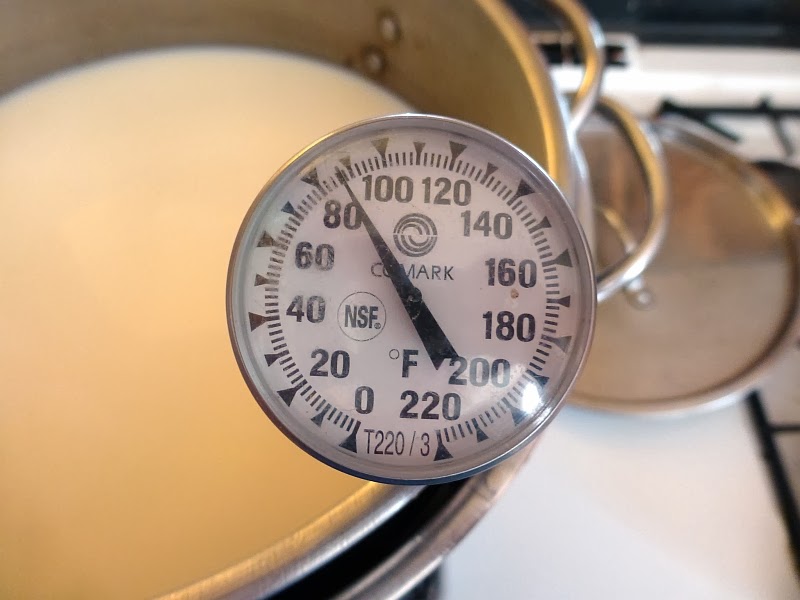
The biggest thing with making cheese is keeping an eye on the temperature. A thermometer is essential.

Anyway, I start with two gallons of whole milk. I nest my pots double-boiler style so nothing burns.


For the first step, the milk is brought to 86F.


Then I added several cubes of mesophilic culture. Because they're older, they're all sorta mashed together and fuzzy with ice but, as I found out, this didn't seem to affect the viability of the culture. It worked just fine.


Stir and let the cubes melt. Once they're melted and the culture stirred in, let the milk ripen undisturbed for 45 minutes.


Then I add rennet. Rennet coagulates the milk and separates the solid (curd) from the liquid (whey). It has two sources, animal and vegetable. Animal rennet is derived from the stomach of a suckling calf who has never had solid food. Vegetable rennet can be derived from stinging nettles.

I use liquid animal rennet, half a teaspoon diluted in a quarter-cup of cool water.


This is thoroughly mixed in, and then left alone for 45 minutes while it coagulates.


After this, the curds have to be cut. I like to use this long slim knife because it's long enough to go all the way to the bottom of the pot.


Curds have to be cut in a criss-cross direction, sliced about 1/2" apart. First one way...


...then cross ways...


...then on a diagonal both directions. This breaks the curds up as evenly as possible in a deep pot.


After the curds "rest" for five minutes, the next step is to gradually heat the curds to 100F over a period of half an hour. Took me awhile to get this step down, as I kept heating the curds too rapidly. During this process, the curds get stirred every few minutes.


When the curds reach 100F, maintain the temperature and stir once in awhile, for thirty minutes.


Then I leave the curds alone for 20 minutes to let them set. During this time, they will sink to the bottom of the pot. See? A waiting period here, a waiting period there... cheesemaking is a long process punctuated by a lot of time doing nothing.


While the curds rested, it was time to get out the cheese press. Long ago, we knew we couldn't afford one of those whiz-bang shiny metal cheese presses ($280!!!), but when Don learned there were plans available (for $5) to make a homemade lever-arm cheese press, he announced "Plans? I don't need no stinkin' plans!" He disappeared into the shop and emerged a few hours later with a handmade lever-arm cheese press. Man, I love my woodworking husband!


He marked the arm with the standard weights I use: 20, 40, and 50 pounds. It turned out I often use 10 lbs. too, so I "wing it" on the arm.

The press has a bucket of sand/gravel/old nails used as a counter-weight.


I needed to make sure the weight was still accurate. So I brought the press outside along with the bathroom scale to test it.


First I tested it at 20 lbs, then at 40.


Yep, still accurate.


By this time the "resting" period for the curds was finished. Time to pour off the whey. Whey can be used to make ricotta, but I wasn't making ricotta this time so I just poured it down the drain.


After this, I set the colander with the curds over the top pot of the double boiler arrangement, to drain for 15 minutes.


I covered it with the lid to help keep the heat in.


At the end of 15 minutes, I flip the curds onto a cutting board with a towel underneath. The curds are still pretty juicy at this stage, and the towel catches the drips.


Then I slice the curds into big chunks, about three inches long.


I drain the whey out of the top pot of the double boiler, and put the chunks of curds back into the pot.


Then comes a two-hour interval where the curd pieces are maintained at 100F. The curds are flipped every 15 minutes. About every other "flip," I insert the thermometer and see how close the temperature is to 100F. At this stage the curds can handle a little fudge factor, so I don't fret if it's a few degrees one way or the other. If the curds are too cool, I turn the gas on low for a minute or two. If the curds are too warm, I pull the top pot out of the double boiler and let it sit on a towel for awhile.


At the end of two hours, the curd pieces are tough and resemble boiled chicken breast meat.


At this point, each piece needs to be diced. I cut lengthwise through each piece before cutting criss-cross.


Put all the diced pieces back into the pot. Cover and maintain the temperature at 100F for 30 minutes. Every ten minutes or so, I stir the pieces with my fingers -- not squeezing, just keeping the pieces from matting together. About halfway through this process, I add two tablespoons of cheese salt. "Cheese salt" is merely non-iodized table salt (apparently iodine can kill the lactic bacteria during the aging process).


At this point I get my form and follower ready. These are tough polypropylene molds. The form (the cylindrical piece) is perforated, and the follower fits snugly inside to press the cheese. While I always advocate for homemade versions of things whenever possible, this is probably one of the few things I recommend buying new, if you plan to make a lot of cheese. It's not wildly expensive, and it will last forever.


I put the form on the floor of the cheese press...


...and line it with a thin piece of old clean sheeting. Some people swear by cheesecloth, but I hate the stuff (it tangles and is hard to re-use). Instead I keep large squares of old clean sheeting on hand for any number of uses, including dairy.


Then the diced curd pieces get stuffed into the form. And I mean stuffed. Sometimes I have to press down to cram it all in, though in this batch it all fit easily.


Then I fold the excess cloth over the top, kinda stuff it in place. The idea is not to have any sheeting hanging over the edge. Makes for a lumpy top of the cheese, but oh well.


Then I fit the follower into the form, compressing both the curds and the wadded up sheeting beneath it.


Then I swing down the arm of the press and fit the foot into the follower.


Then I slide the weight onto the arm. The 10-pound line isn't marked, but we know about where it is. A little "fudging" won't hurt the cheese at this point. The weight stays at 10 lbs. for 15 minutes.


Right away, whey starts squeezing out of the curds. We always position the cheese press so the end tips over an old unused sink, to allow the whey to drain out.


At the end of 15 minutes, I remove the weight and lift the arm, which also lifts the foot. I remove the follower and flip the cheese upside down. Then I reinsert the follower and the foot.


This time I place the weight at 40 lbs.


The weight stays at 40 lbs. for twelve hours. Early the next morning, I flipped the cheese once again and set the weight at 50 lbs., where it stays for 24 hours.

Then I remove the cheese from the press...


...and push it out of the form.


I carefully peel the cloth from the cheese (I can wash and re-use the cloth). Can you see why people say the moon resembles green cheese?


I keep the cheese on a rack for about three days in order to form a rind. The rack allows air to get beneath the cheese to harden it on all sides.


Then it's time to wax the cheese. Cheese wax is different than paraffin wax. It's flexible and won't crack, and it can be cleaned and reused. I got a five-pound block of red cheese wax a few years ago. When it melted (which took hours!), I poured it into this el cheapo tin I got at a thrift store.

To wax cheese, I put the tin of hard wax in a pot of water with a rack on the bottom of the pot, and slowly melt the wax. It will take at least an hour to melt, so here's another opportunity for patience. In theory wax can catch fire, so I keep the heat low.


Once the wax is melted, I lay a sheet of waxed paper next to the wax to catch the drips.


Then I pick up the cheese and dip the bottom half once, twice, three times. I let the wax cool for about ten seconds between dips.


I lay the cheese on the waxed paper, wax side up, for about two or three minutes to cool.


Then I pick it up by the waxed side...


...and dip the other half once, twice, three times.


I managed to wax my fingers.


I left a couple of bare spots, in this instance where my thumb was holding the cheese.


That's where the paintbrush comes in. I just painted wax over the bare spot.


After this I write the date on a small slip of paper...


...and paint a thin coat of wax over it to secure it to the cheese.


I'll age this cheese for about 2 1/2 months. The difficulty is finding a place to store it where it stays at a consistent 55F. I borrowed a neighbor's small dorm-size fridge and set it at its lowest setting, but it's far cooler than 55F, so right now I'm a bit stumped. Thoughts as to where I can find a 55F environment?

UPDATE: Thanks to reader recommendations, shortly after posting this blog post I purchased a used wine cooler refrigerator. It's worked perfectly to maintain the cheese temperature during aging.