Showing posts with label yogurt. Show all posts

Monday, September 16, 2013

Making yogurt

Little Amy is doing just fine, being bottle-fed. She's frisky and cheerful, and comes right over to see us (as her main food source) whenever we walk by. What's nice is she has the best of both worlds: even though she's being hand-raised, she still has the security of a loving mama.

Here Amy meets Jet.


But since I'm milking Matilda twice a day, I'm also swimming in milk.

When we first got Matilda five years ago, she came straight off a commercial dairy. She had mastitis and scabs on her teats. These were nightmare issues but eventually cleared up (except for one quarter, which the mastitis killed off) and became a wonderful milk cow. But since she didn't have a calf on her, we were swimming in milk. At her peak output, I was getting five gallons a day.

When Matilda had her first calf with us about three years ago and I began milking once a day, I noticed something interesting: her cream output decreased sharply. Even when she was separated from her calf all night and her morning milk was abundant, it was a lot less rich in cream. I've come to realize this just happens when a nursing cow is milked.

But this time I'm getting Matilda's full output, about three gallons a day. One gallon goes to the calf (split between two feedings), but the rest is for us. And once again, because she's not nursing Amy directly, her milk is rich in cream.

So in some regards it's the best of both worlds for us, too. Matilda gets to keep her calf, and we get all the milk. (Well, most of the milk.)


This means I have to do something with it. Yesterday I decided to make a batch of yogurt, one of the easiest things to make. I had to order a fresh batch of culture, though, since it had been so long since I'd made any. I like Bulgarian culture, since I can re-culture it for a long time.


It gives clear instructions on the back.


I heated two quarts of skimmed milk to 180F. I also like to add about a half cup of instant milk, as that makes the yogurt creamier.


When the milk gets to 180F, turn off the heat and let the milk sit until it cools to about 110F.


The cooled milk will form a skin on top. I take it off and discard it.


Then and only then is the yogurt culture added. Once or twice in the past, I've unthinkingly added the culture when the milk is still 180F, and of course it kills the culture right away.


Mix the culture into the milk thoroughly.


Then the milk has to incubate. Any way you can keep it warm will work -- wrapped in towels and put in a Styrofoam ice chest, placed in a warm sunny location, whatever. A few years ago I sprang for a yogurt incubator called a Yogotherm and have been very pleased with it.


This incubator is just a plastic bucket inside a thick Styrofoam sleeve and lid, and it insulates very well.


The yogurt should incubate a minimum of 5 to 7 hours. I like my yogurt to be a bit tart, so I usually incubate for about twelve hours. At the end of that time, the yogurt is firm and custardy in consistency. I pull off a few ounces and keep it for my next starter batch.
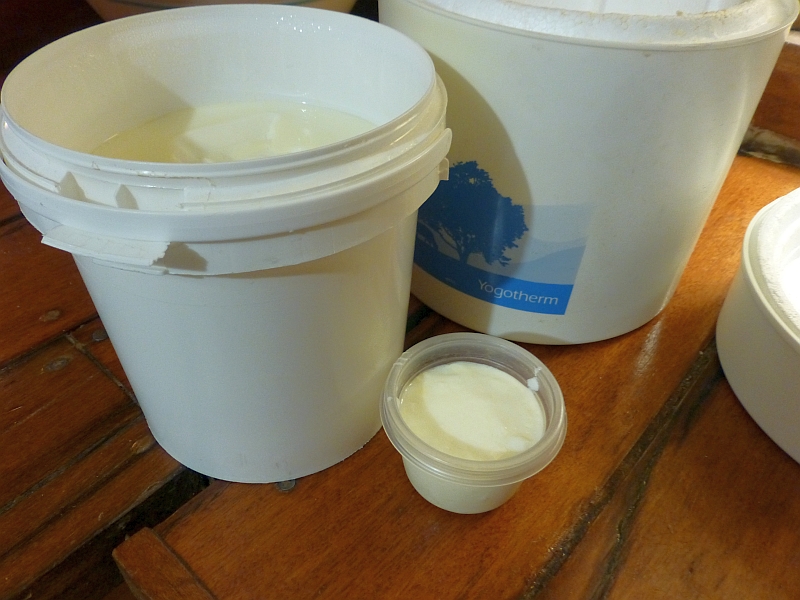

Then I chill the yogurt in the refrigerator. Of course yogurt can be flavored however you wish. I usually add a cup of Splenda and some peach purée.


Just before eating, I like to scoop granola or Grape Nuts-type cereal into it.


Yogurt is one of the easiest-peasiest dairy products to make. With Matilda giving so much milk, I have a feeling I'll be making a lot of it.

Sunday, May 30, 2010

Making yogurt

A reader asked how to make yogurt. It just so happened I had some pictures of the process but never got around to posting them. So...here goes.

Start with two quarts of milk. I like to use skim milk.


Add 1/4 cup of nonfat dry milk. This will add to the creaminess of the yogurt. Mix thoroughly and slowly heat the milk to 180F.


Don't stir during this time, just let the milk gently heat. When it hits 180F, turn the heat off and let it cool to between 105F and 115F. Again, don't stir. When the milk is cooled, there will be a thick nasty skin on top. Scoop this off and discard.


I like to use Bulgarian yogurt starter. I order mine from the New England Cheesemaking Supply Company. The reason I use Bulgarian starter is because it can recultured indefinitely.


Whatever you do, do NOT add the yogurt culture to the milk when it's hotter than 115F because it will kill the culture (been there, done that). Stir gently until the culture is thoroughly mixed.


Now the milk has to be incubated for a minimum of 5 to 6 hours (I usually incubate mine about 12 hours because I like a tarter yogurt). Anything can be used as long as the milk stays warm. Several years ago I bit the bullet and bought a Yogotherm Yogurt Maker. The reason I like this is it's nonelectric - it's literally just a plastic bucket that nestles inside a Styrofoam sleeve. You could probably put the milk behind the woodstove in order to stay warm; or inside a gas oven with a pilot light; or wrapped in towels and tucked inside a small ice chest. Use your creativity to come up with some way to keep the milk warm.


After the yogurt has incubated for several hours, remove the plastic bucket from the incubator and refrigerate overnight (or about 12 hours).

Before flavoring the yogurt, scoop out a few ounces and put it in a small container. Keep this in the fridge. This is your starter for the next batch.


To sweeten the yogurt, I use one cup of sugar or Splenda, then either add 1/4 cup vanilla (for vanilla yogurt) or some peach purree (peaches are my favorite fruit). Obviously you can flavor it however you like and to your taste.

Saturday, May 23, 2009

Busy day

Here's what we did today.

No cougar disturbances during the night. This morning, though, we moved the livestock into a new (small) pasture for a few days. This has the advantage that our bedroom window overlooks it. If there's a commotion during the night, we'll hear it more easily. And at least we'd be running through open field in pitch darkness with the shotgun instead of crashing through forest and tangled underbrush in pitch darkness with the shotgun. Besides it was time to rotate the cows anyway - the other pasture was eaten down.


I also had a day of processing milk. Matilda's up to almost five gallons a day, so I gotta do something with it. This morning I skimmed off all the cream I had in the fridge and warmed it to 80 degrees, then made butter. Here's five pounds of butter half-way through the washing stage.


Then I weighed it out in one-pound increments...


Laid them out on waxed paper...


Then wrapped them in one-pound butter balls. These go in the freezer.


I also made yogurt (this is the incubator). It will be ready by tonight, and I'll chill it overnight.


Here's my stove and counter at one stage. To the left is two gallons of milk in nested pots (for a double boiler) being made into cheddar. The weird striped can with the teddy bear is an el-cheapo tin I picked up at a thrift store. It's full of cheese wax, which is slowly melting so I can wax some cheese. The yellow things behind it are five air-dried batches of cheddar, overdue for waxing. The white jugs are what I use for milk, cleaned and drying.


Here's the cheese, half-waxed...


And fully waxed. I'll date it and let it age for 2 1/2 months.


Meanwhile, I helped Don put the auger on the tractor so he can start constructing a chicken coop.


He drilled two holes.


Matilda doesn't know what to make of this hole in the ground...


or the auger.


He put some pressure-treated 4x4's in concrete and braced them in place. That's all he could do today until the concrete dries.


A chicken coop is imperative because we got thirty chicks yesterday. We butchered our old flock last fall because they had stopped laying, and when we got Matilda we converted the old chicken coop into the milking shed. Now we need another coop.

Here are the chicks.


The yellow ones are Cornish-crosses, which are meat birds. They will gain weight with such awesome speed that they'll be ready to butcher in three months tops. The rest of the birds are for eggs, and they're a mixture of Barred Rocks, Rhode Island Reds, Wyandottes, and Aracaunas. We won't get eggs for about six months, though.


That's all. As I said, busy day.