Now that very early fall is upon us -- yes, in north Idaho we start noticing the effects of autumn in early August -- I thought it was time for a garden update.
As a brief recap for new readers, we don't garden in the ground; we garden in tires, mostly tractor tires. Long story short: heavy clay soil and too many weeds resulted in a nine-year battle for a successful garden. When we paved the garden space with tarps and gravel and installed huge honkin' tires filled with a lovely mixture of topsoil/ compost/sand, we've enjoyed a successful garden ever since.
First, corn. I got it planted late this year -- I planted it in two batches, June 15 and June 21 -- but I have absolutely confidence in this particular variety of corn.
Corn has been problematic for us from the start because of our short growing season and high winds. Tall corn simply topples over, and with few exceptions all corn varieties take too long to produce ears before the first frost hit.
So when I came across a short-season heirloom sweet corn at
Victory Seeds called
Yukon Chief, I was intrigued. Developed at the University of Alaska in 1958, it produces ears only 55 days after germination. This is our third year growing it, and I'll never grow anything else. It's a dwarf variety so the plants seldom get over three feet tall, and the ears are fairly small (topping out at about five inches), but it's sweet and wonderful and grows beautifully in our area.
I fully expect ripe ears by the end of August or early September.
This is the garlic. It's ready to harvest, and I'll probably pull it today or tomorrow.
I have sixteen tomato plants in smaller tires.
Nothing ripe yet, but lots of large green potential.
What Don doesn't eat fresh (he
loves fresh tomatoes!), I'll
strain and freeze, then
make sauce and can it during the winter.
The carrots I let overwinter to form seeds are enormous, often tipping over from their sheer weight.
I've never let carrots go to seed before, and it's been fun to watch. The heads are thiiiiis close to being mature. One thing's for sure, the sheer volume of seed that comes from even one single carrot is enormous.
The strawberries are past their production, of course, and to be honest it's a relief.
Why? Because this year we harvested -- are you ready for this? -- a staggering
160 pounds of strawberries.
It was an enormous challenge to pick them all. Toward the end, we were practically running a you-pick for all the neighbors, inviting them to take what they wanted, the only requirement that I be allowed to weigh the fruit (for my seasonal tally) before they took it home.
Over the course of one month, we got 160 lbs. exactly (not counting what we snacked on as we picked). Everything we kept is washed and hulled and bagged up in the freezer, ready for strawberry desserts all winter long.
Meanwhile the experimental
pineberries I planted last spring -- and subsequently nearly killed off when I forgot to water them during an early heat wave -- have branched out from the remaining plants and propagated across the tires. No fruit this year, but I'm encouraging them to send out every runner they can to populate the beds.
I grow several types of herbs. Here's sage:
Oregano:
Spearmint:
Horseradish:
(By the way the nice thing about tire gardening is I can grow stuff that spreads by roots, like mint and horseradish, without fearing it will take over the whole garden.)
Rosemary. Several of the herbs overwinter very well -- oregano, sage, horseradish, mint, thyme -- but I haven't had any luck with rosemary until this year. Sorta. You can't see it very well, but there's a small center plant that overwintered for the first time. The rest are store-bought. My mother used to grow enormous bushes of rosemary that got bigger and bigger every year, but what's possible in California isn't always possible in north Idaho.
Basil. I tucked basil in a couple of different beds, wherever there was room. This is growing with the spearmint:
And this is growing among some lettuce going to seed.
By the way, in this same bed is a heliotrope plant. I've always heard about the divine smell of heliotrope, and when I saw some plants on sale a couple months ago, I picked one up on impulse. Yep, it smells divine. A bit too strong for an indoor plant, but charming outdoors.
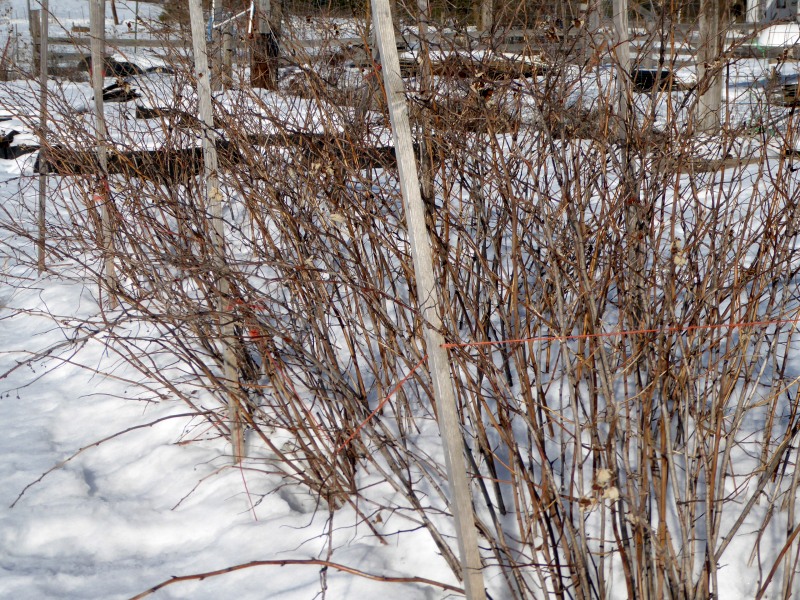
The raspberries are past their production, of course, but we picked and froze several gallons of berries.
The new blueberry bushes I
planted last year are still in their growth phase. I got maybe a dozen berries from them (very sweet!), but they're healthy and strong and they'll start coming into their own in the next few years.
The mature blueberries gave me 18.5 lbs. of fruit this year, a nice haul.
But -- frustratingly -- I
cannot control the weeds around these plants. Some readers might recall how I
transplanted these long-suffering bushes from a very weedy spot five years ago, but unfortunately I also transplanted some very stubborn grasses that are spreading vegetatively.
Last year I dug up one of the bushes in winter and tried without success to tease out the blueberry's roots from the grasses. It was an utter failure, and all I did was kill the blueberry. After the newer bushes reach maturity, we'll probably take out this entire bed (saving what blueberry plants we can), tarp and gravel the ground, install a new bed, and replant. But that's several years in the future.
Red bell peppers. I bought these as seedlings. I have others I started in the house and they're also thriving, but I planted them late so I don't know if they'll produce.
However the store-bought seedlings have lots of peppers. These should start turning red shortly.
I won't be harvesting broccoli or Brussels sprouts, unfortunately.
That's because the broccoli has flea beetles.
Flea beetles are tiny jumping beetles that can turn a healthy plant into a lacy skeleton of its former self.
I'm going to try dusting the leaves with diatomaceous earth to see if it helps.
The Brussels sprouts, unfortunately, have aphids. I made some foul-smelling spray (water, soap, and chopped up onions, garlic, and hot peppers) to no avail; they're tucked into every nook and cranny.
I have lots and lots of lady bugs, too, but not enough to save the Brussels sprouts. Oh well, keep trying, little guys.
Aphids aren't the only thing tucked among the leaves. I saw this clever little fellow.
These are cayenne peppers. I have them planted in multiple beds.
A funny thing about the cayennes: last year I started an entire tray, 50 plants, in the house, but when I transplanted them, only 15 survived. We got a nice little harvest of peppers, but Younger Daughter goes through them pretty regularly. So this year I started 75 plants indoors in February. I transplanted about 60 of them and gave extras to neighbors. And what do you know? I didn't lose a single plant, so we're about to be buried in cayennes.
Onions. I'm growing two types. The first is just regular yellow onions grown from store-bought sets. These will be the first we'll eat, because they don't last long after harvesting (we don't have a root cellar). I have two beds of these onions.
This is the second bed. Notice the big honkin' volunteer potato plant in the middle of it. I have so many volunteer potatoes growing in so many different beds that I didn't bother planting any new potatoes.
The other type of onion I'm growing are
potato onions (sometimes called multiplier onions). I had never heard of this variety before a reader brought them to my attention and kindly send me about a pound to plant. They're smaller than regular onions, but they store beautifully and have a nice bite. They're planted in the fall, like garlic, and right now they're about ready to harvest.
I'm tickled to death with these because before this, I couldn't propagate my own onions. Now, like the garlic, we can grow these
ad infinitum. However since they're not as large as regular onions, we'll grow both types because larger onions are nice as slicers for sandwiches.
One of the beds of volunteer potatoes.
The
second planting of peas are juuuust starting to emerge.
The grapes we
planted earlier are doing well and starting to climb the trellis. No fruit this year, of course, but hopefully next year.
On a whim I also planted a single morning glory amidst the grapes, and it quickly became apparent why morning glories are considered a weed among crops -- they spread and twine onto everything, including the grapes.
I'll have to pull out the morning glory soon lest it strangle the grapes.
So how's our new baby orchard doing, you may ask? In a word, beautiful. Absolutely flippin' beautiful.
For those following our gardening journey, you might recall when we planted our
baby orchard last May -- in gigantic tractor tires. This was entirely experimental and I do not know of anyone, anywhere, who has ever planted fruit trees in tires. But we've learned the hard way what happens when we plant directly in the ground.
Within each tire, at the base of all the trees, we planted wildflowers to help feed the bees. The flowers are blooming beautifully.
The trees are thriving so far. We planted two plums, and four each of peaches and apples. Here's one of the plums:
Of course we pinched off any fruit from these trees, especially for this first year, but we missed a plum and it's developing nicely.
Here's one of the apples:
I'm especially hopeful for the peaches, since peaches are, hands down, my all-time favorite fruit.
On each tire, I painted the type of tree it is, so I wouldn't forget or get them mixed up.
Meanwhile our mature pear tree -- one of two surviving pears from our original orchard attempt many years ago -- is bearing prolifically.
That's it for the garden tour. Ya'll come back now, hear?