I'm not kidding, this really happened.
I saw a headline on Drudge last night that read:
My first thought? "Banning Jerseys? What about Dexters? What about Holsteins? Why Jerseys?"
Methinks I've been living on a farm for too long.
Showing posts with label Jerseys. Show all posts
Saturday, October 19, 2013
Friday, April 30, 2010
When nature wins
I've had a nightmare of a day.
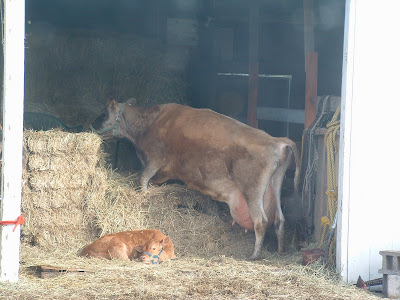
It started early this morning when I heard Matilda, our Jersey cow, bellowing. She didn't stop either. "What's the matter, she lose her calf?" I kept asking, but the calf was always within easy sight.
The problem became abundantly clear when we saw Gimli, our bull, who should NOT be on this side of the fence. But he was. (Fences, take note, are largely decorative.) And Gimli was dancing such close attendance on Matilda that it was clear our dear girl was in heat.
Unlike the subtle heat cycles of our Dexters, when a Jersey's in heat you know it. They bellow fit to kill. And in such a state, Gimli thought Matilda was the sexiest thing this side of...well, the fence.
But it's the wrong time of year for her to breed. A cow's gestation is 9 months, 10 days. That would put the birth squarely in the middle of next February. We got lucky this year with Pearly's birth because we've had a mild winter, but undoubtedly we won't be so lucky again.
So we had to keep them apart. Ha. Correction -- **I** had to keep them apart, because Don had to be away for the day. Double ha.
To make things more exciting, our ten-month-old bull calf Beefy suddenly "discovered girls." Beefy is a short-legged Dexter which puts him about the same size as Pearly right now, though he is, of course...well, beefier. The size difference between he and Matilda is laughable - but he wasn't about to let a little thing like logistics stop him.
Normally Gimli is very tolerant of Beefy. In fact, the two are best buds. But not when there's a sexy hot cow in the area! And for some reason, Matilda was showing a distinct preference for Beefy. Oh joy.
I started by pulling Matilda into her milking stall and slamming the door shut against Gimli's eager escort. He bellowed and paced and went into the barn adjacent to her stall. Hey bingo, problem solved! I locked him in and milked Matilda. Make a note: cows don't give a lot of milk during their heat cycles. I came away with barely a pint, then let Matilda out.
Well, Gimli's confinement lasted a couple hours until he found he could force aside a weak part in the barn wall and get into the woods again. Soon he had hopped the fence and was back with his lady love.
Okay, so I locked Matilda into her milking stall again, this time for much of the day. This worked, but it left a bull on the loose who wasn't about to cooperate and go meekly back into the wooded side of the fence.
The complications with Beefy, however young and small he is, were such that in frustration I called Potlatch Pack (the local mobile butchering service) and made a date on May 10 to put Beefy in the freezer. Can't have TWO bulls around the place.
The neighbor kids wanted to come over, so I told them I'd meet them at the fence and escort them into the house, which I did. Later the girls wanted to go over to the boys' house, so again I escorted everyone to the fence and ordered the girls to call me before they came home. Can't take chances with a horny bull.
By mid-afternoon, I had a splitting headache, compounded by the constant bellowing between Gimli and Matilda, with a few bleats thrown in by Beefy and Pearly. I needed to clean Matilda's stall and get her some fresh water and food, but couldn't do it with Gimli in constant attendance. So I pulled Matilda into the barn adjacent to her stall and let Gimli sniff her over the boards from the hay side.
Big mistake. I thought he was going to jump (climb?) over the five-foot-high boards to get at her. Hastily I pulled Matilda back into her dirty stall and let Gimli into the barn and locked him there. I knew I didn't have long before he escaped, but at least I could release Matilda long enough to clean her stall. Musical cows, anyone?
And oh my, wasn't Beefy pleased about this arrangement! Here's this sexy thing all to himself, without Gimli chasing him off! He was on her hammer and tongs - as I said, the size difference is laughable, but I'll give him credit for trying.
Meanwhile with Gimli bellowing his sexual frustration in my ear and huffing at the loose part of the barn wall, I hastily cleaned Matilda's stall. Soon I heard the crashing noise that indicated Gimli was out of the barn into the woods, and knew I had about two minutes to get Matilda back into her stall before Lover Boy came dashing over the fence. (Remember, fences are merely decorative - especially when hormones are concerned.) I didn't have food or water in the stall yet, but at least the floor was clean.
So I grabbed a lead rope, ran over to Matilda (who wasn't pleased to see me) and clipped it to her halter. And then I pulled and dragged and tugged and dragged some more because hey, she didn't want to give up the attentions of Beefy (who, believe me, was mounting with great enthusiasm) without a fight. I was able to finally get her into her stall and chase Beefy out just as Gimli came pounding up.
Slamming doors left and right and grabbing the pitchfork in defense while Gimli paced outside her door and bellowed, I did the kids' barn chores - filling the water tank and feeding and watering the chickens - because I didn't want them out with Gimli. It's not that he was out to "get" anyone - Dexter bulls are actually quite sweet-tempered - but we can't forget he's still a bull and is therefore unpredictable, especially in his sexually-charged state.
By this time Younger Daughter was ready to come home, so I met her at the neighbor's fence with a pitchfork and escorted her to the house. I also told the dogs they weren't getting a walk that night.
I was exhausted and the headache was worse, so I finally called my husband and said, "How do you feel about just letting Gimli have his way with Matilda and giving her a shot of Lutalyse later on?" Lutalyse is an abortant and we sometimes use it to abort an ill-timed pregnancy in our cows.
He agreed this was the most prudent course of action, and with no small amount of relief (for ALL parties concerned) I let Matilda out of her stall and let the boys have her.
We REALLY need to build a bull pen.
What's that you say about living the "simple" life? Okay, quit laughing.

Beefy thinks it's worth a shot.

Gimli disagrees and chases him off.

Ah, sweet hormones!

Notice Beefy (nuzzling Matilda) isn't a whole lot bigger than Pearly (red calf on left).

Beefy hasn't quite caught on yet...

...which doesn't keep Matilda from showing her preference.

But at least Gimli knows which end is which.

It started early this morning when I heard Matilda, our Jersey cow, bellowing. She didn't stop either. "What's the matter, she lose her calf?" I kept asking, but the calf was always within easy sight.
The problem became abundantly clear when we saw Gimli, our bull, who should NOT be on this side of the fence. But he was. (Fences, take note, are largely decorative.) And Gimli was dancing such close attendance on Matilda that it was clear our dear girl was in heat.
Unlike the subtle heat cycles of our Dexters, when a Jersey's in heat you know it. They bellow fit to kill. And in such a state, Gimli thought Matilda was the sexiest thing this side of...well, the fence.
But it's the wrong time of year for her to breed. A cow's gestation is 9 months, 10 days. That would put the birth squarely in the middle of next February. We got lucky this year with Pearly's birth because we've had a mild winter, but undoubtedly we won't be so lucky again.
So we had to keep them apart. Ha. Correction -- **I** had to keep them apart, because Don had to be away for the day. Double ha.
To make things more exciting, our ten-month-old bull calf Beefy suddenly "discovered girls." Beefy is a short-legged Dexter which puts him about the same size as Pearly right now, though he is, of course...well, beefier. The size difference between he and Matilda is laughable - but he wasn't about to let a little thing like logistics stop him.
Normally Gimli is very tolerant of Beefy. In fact, the two are best buds. But not when there's a sexy hot cow in the area! And for some reason, Matilda was showing a distinct preference for Beefy. Oh joy.
I started by pulling Matilda into her milking stall and slamming the door shut against Gimli's eager escort. He bellowed and paced and went into the barn adjacent to her stall. Hey bingo, problem solved! I locked him in and milked Matilda. Make a note: cows don't give a lot of milk during their heat cycles. I came away with barely a pint, then let Matilda out.
Well, Gimli's confinement lasted a couple hours until he found he could force aside a weak part in the barn wall and get into the woods again. Soon he had hopped the fence and was back with his lady love.
Okay, so I locked Matilda into her milking stall again, this time for much of the day. This worked, but it left a bull on the loose who wasn't about to cooperate and go meekly back into the wooded side of the fence.
The complications with Beefy, however young and small he is, were such that in frustration I called Potlatch Pack (the local mobile butchering service) and made a date on May 10 to put Beefy in the freezer. Can't have TWO bulls around the place.
The neighbor kids wanted to come over, so I told them I'd meet them at the fence and escort them into the house, which I did. Later the girls wanted to go over to the boys' house, so again I escorted everyone to the fence and ordered the girls to call me before they came home. Can't take chances with a horny bull.
By mid-afternoon, I had a splitting headache, compounded by the constant bellowing between Gimli and Matilda, with a few bleats thrown in by Beefy and Pearly. I needed to clean Matilda's stall and get her some fresh water and food, but couldn't do it with Gimli in constant attendance. So I pulled Matilda into the barn adjacent to her stall and let Gimli sniff her over the boards from the hay side.
Big mistake. I thought he was going to jump (climb?) over the five-foot-high boards to get at her. Hastily I pulled Matilda back into her dirty stall and let Gimli into the barn and locked him there. I knew I didn't have long before he escaped, but at least I could release Matilda long enough to clean her stall. Musical cows, anyone?
And oh my, wasn't Beefy pleased about this arrangement! Here's this sexy thing all to himself, without Gimli chasing him off! He was on her hammer and tongs - as I said, the size difference is laughable, but I'll give him credit for trying.
Meanwhile with Gimli bellowing his sexual frustration in my ear and huffing at the loose part of the barn wall, I hastily cleaned Matilda's stall. Soon I heard the crashing noise that indicated Gimli was out of the barn into the woods, and knew I had about two minutes to get Matilda back into her stall before Lover Boy came dashing over the fence. (Remember, fences are merely decorative - especially when hormones are concerned.) I didn't have food or water in the stall yet, but at least the floor was clean.
So I grabbed a lead rope, ran over to Matilda (who wasn't pleased to see me) and clipped it to her halter. And then I pulled and dragged and tugged and dragged some more because hey, she didn't want to give up the attentions of Beefy (who, believe me, was mounting with great enthusiasm) without a fight. I was able to finally get her into her stall and chase Beefy out just as Gimli came pounding up.
Slamming doors left and right and grabbing the pitchfork in defense while Gimli paced outside her door and bellowed, I did the kids' barn chores - filling the water tank and feeding and watering the chickens - because I didn't want them out with Gimli. It's not that he was out to "get" anyone - Dexter bulls are actually quite sweet-tempered - but we can't forget he's still a bull and is therefore unpredictable, especially in his sexually-charged state.
By this time Younger Daughter was ready to come home, so I met her at the neighbor's fence with a pitchfork and escorted her to the house. I also told the dogs they weren't getting a walk that night.
I was exhausted and the headache was worse, so I finally called my husband and said, "How do you feel about just letting Gimli have his way with Matilda and giving her a shot of Lutalyse later on?" Lutalyse is an abortant and we sometimes use it to abort an ill-timed pregnancy in our cows.
He agreed this was the most prudent course of action, and with no small amount of relief (for ALL parties concerned) I let Matilda out of her stall and let the boys have her.
We REALLY need to build a bull pen.
What's that you say about living the "simple" life? Okay, quit laughing.
Beefy thinks it's worth a shot.
Gimli disagrees and chases him off.
Ah, sweet hormones!
Notice Beefy (nuzzling Matilda) isn't a whole lot bigger than Pearly (red calf on left).
Beefy hasn't quite caught on yet...
...which doesn't keep Matilda from showing her preference.
But at least Gimli knows which end is which.
Tuesday, April 13, 2010
Homesteading Question #2
A reader asked the following questions:
1. How would you describe Dexter milk, as compared to Jersey? Flavor? Butterfat composition? Quantity?
2. How would you describe Dexter beef? I see you still keep Dexters. I am wondering what purpose they serve for you?
3. Would you mind sharing any of your cheese making recipes? Particularly your cheddar and cream cheese methods? In fact, I would LOVE to hear what your home dairying routine looks like on your homestead. How do you manage the milk production on a weekly basis. I've been at this for a year and still haven't really gotten this down.
Size difference between a Jersey and a Dexter:

My answers:
1. I've found a more consistent flavor with Dexter milk, but possibly it's because I wasn't prepared for the unbelievably high butterfat content with the Jersey. I never got a lot of cream from my Dexters but I now realize it's probably because I always had calves on them. My first year with our Jersey, she had no calf on her and up to 50% of her milk was cream. We had to skim it before drinking because it was so rich it almost tasted bad (like drinking, well, pure cream - okay for a mouthful, too rich after that). Skimmed, it was delicious. Now that our Jersey has a calf, I only get about 25% of her milk as cream. I still skim, of course, but the calf is taking a lot of the richness from the milk. Don't get me wrong, I consider this an advantage. Bottom line, I like both Dexter and Jersey milk just fine. I like having more milk (ie. the volume I get from our Jersey) because I like making cheese.
As far as quantity - it's a little hard to gauge because I treated our Dexters differently than our Jersey. I milked the Dexters once a day, kept their calves on them, and got anywhere from a quart to a half-gallon per day per animal. (Keep in mind that all cows milk on a bell curve - they calve, start lactating, and peak when the calf is about a month old. After that they'll gradually decrease over the next few months. There are also day-to-day variations in milk production.) When we got our Jersey from the commercial dairy herd, she had no calf and I got anywhere from two to five gallons a day, depending on the time of year. Now that she has a calf, I'm getting anywhere from half a gallon (rare) to two gallons a day from her.
2. Dexter beef is indescribably delicious. I mean seriously, compared to the junk you buy in grocery stores, our beef is mouth-watering. Even our five-year old bull we butchered last year wasn't bad (animals that old are pretty tough). Most of the bull got turned into ground beef and roasts (rather than the more tender steaks) but he was still delicious. We butcher our steers anywhere from 18 to 24 months of age.
3. I'm working on an article on cheesemaking for Backwoods Home Magazine, so I'll be posting extensively on that subject within the next week or so.
1. How would you describe Dexter milk, as compared to Jersey? Flavor? Butterfat composition? Quantity?
2. How would you describe Dexter beef? I see you still keep Dexters. I am wondering what purpose they serve for you?
3. Would you mind sharing any of your cheese making recipes? Particularly your cheddar and cream cheese methods? In fact, I would LOVE to hear what your home dairying routine looks like on your homestead. How do you manage the milk production on a weekly basis. I've been at this for a year and still haven't really gotten this down.
Size difference between a Jersey and a Dexter:
My answers:
1. I've found a more consistent flavor with Dexter milk, but possibly it's because I wasn't prepared for the unbelievably high butterfat content with the Jersey. I never got a lot of cream from my Dexters but I now realize it's probably because I always had calves on them. My first year with our Jersey, she had no calf on her and up to 50% of her milk was cream. We had to skim it before drinking because it was so rich it almost tasted bad (like drinking, well, pure cream - okay for a mouthful, too rich after that). Skimmed, it was delicious. Now that our Jersey has a calf, I only get about 25% of her milk as cream. I still skim, of course, but the calf is taking a lot of the richness from the milk. Don't get me wrong, I consider this an advantage. Bottom line, I like both Dexter and Jersey milk just fine. I like having more milk (ie. the volume I get from our Jersey) because I like making cheese.
As far as quantity - it's a little hard to gauge because I treated our Dexters differently than our Jersey. I milked the Dexters once a day, kept their calves on them, and got anywhere from a quart to a half-gallon per day per animal. (Keep in mind that all cows milk on a bell curve - they calve, start lactating, and peak when the calf is about a month old. After that they'll gradually decrease over the next few months. There are also day-to-day variations in milk production.) When we got our Jersey from the commercial dairy herd, she had no calf and I got anywhere from two to five gallons a day, depending on the time of year. Now that she has a calf, I'm getting anywhere from half a gallon (rare) to two gallons a day from her.
2. Dexter beef is indescribably delicious. I mean seriously, compared to the junk you buy in grocery stores, our beef is mouth-watering. Even our five-year old bull we butchered last year wasn't bad (animals that old are pretty tough). Most of the bull got turned into ground beef and roasts (rather than the more tender steaks) but he was still delicious. We butcher our steers anywhere from 18 to 24 months of age.
3. I'm working on an article on cheesemaking for Backwoods Home Magazine, so I'll be posting extensively on that subject within the next week or so.
Labels:
cheesemaking,
Dexters,
home dairy,
Jerseys,
milking
Sunday, April 11, 2010
Homesteading Question #1
Over the past couple years, I've had readers email me with various and sundry questions about homesteading. I've kept my answers in a separate file because I never knew when I'd be able to recycle all or part of an answer. It finally dawned on me - duh - that these types of questions and answers are perfect for posting on a blog. This will be the first in a series, posted sporadically as they arise.
Following is an email from a reader about my recent article on dairy cows in Backwoods Home Magazine. My lengthy reply follows.
__________________________________
Hello Patrice!
Could you please give me a little information/encouragement (!?) on dairy cattle? We are currently raising dozens of chickens, a few ducks, and a flock of meat goats. We are interested in adding a cow to provide raw milk for our family of four. When convenient, please offer any insight on the following:
-Do you recommend a particular breed? We’re planning to keep it “grass-fed” only.
-What should we look for and what should we avoid?
-Is it o.k. to keep a single cow? Or will she do better if she has a companion?
-Will one cow provide far too much milk for a family of four?
-Anything else you can think of?
One of my greatest “hang ups” is wondering if I am ready for the commitment of twice per day milking. Especially in the winter! We do have a ten year old and a (almost) nine year old, so they can certainly be of help.
Thank you!
Jessica
_____________________________________
Hi Jessica:
Don’t worry, it’s perfectly normal to be nervous about getting your first dairy cow. I knew I was scared spitless, but somehow it all worked out. Sometimes you have to just grit your teeth and DO IT before your fears will abate.
I’ll answer your questions in the order you sent them.
1. Do I recommend a particular breed?
The only breeds with which I have personal experience are Dexters and Jerseys. Dexters are a small Irish breed that are dual-purpose (milk and meat). They are a feistier breed than most. Not aggressive, just feisty. Some people love that. If you get a Dexter, do NOT get one with horns, and look for an animal that is gentle and halter-broken.
We’ve had Dexter since 1999 and only last year got a Jersey (in addition to our Dexters) because I wanted a higher-volume milk animal. And boy howdy did I get it. Our Jersey was giving FIVE gallons a day last summer at the peak of her lactation. This has its advantages (I was making a lot of cheese) and disadvantages (pouring lots of milk down the sink when I couldn’t keep up with her output).
2. What should we look for and what should we avoid?
Avoid horns. My God, avoid horns. If you’re looking at a horned animal for sale, do not buy it.
For your first dairy cow, I strongly recommend one who is halter-broken and is easy to lead around. I was pleasantly surprised how much easier our Jersey was to handle than our Dexters. To be fair, the Jersey came off a commercial herd and is six years old, and was used to be handled; whereas I don’t bother halter-training our Dexters, so of course I’m biased in favor of the gentleness of Jerseys. But lots of Dexters owners I know hand-raise their animals and they’re docile and easy to handle. In the end it’s up to you to go look over the animal in question and try walking her around a corral.
As far as breeds, it depends on what you want. We like our Dexters because the surplus steers fill our freezer and they produce *wonderful* meat. If you want a purely milk animal, I’d recommend a Jersey over, say, a Guernsey or a Holstein. Guernseys have among the highest butterfat content but they’re also *very* heavy producers. Ask yourself if you can handle ten gallons of milk a day. Holsteins produce far less butterfat but much more milk, sometimes as high as 15 gallons a day. So I’d stick with a Jersey.
If you get a lactating cow without a calf on her, you MUST milk twice a day, no exception, and all the milk is yours. With a calf, you might be able to get away with skipping an occasional milking, and you share the milk with a calf. (I never bottle raise calves; I prefer to leave the calf-raising to the mothers.)
3. Is it OK to keep a single cow, or should she have a companion?
Cows are herd animals. They ALWAYS need a companion. That said, nothing says the companion needs to be another cow. Our neighbors had eight horses and one cow, and the poor cow was always being picked on (sometimes aggressively) by the horses. (They were forced to separate them.) Now the cow has some calves so she’s not as lonely, but she spent a lot of her first year mooing pitifully and avoiding the horses.
But your cow may bond with your meat goats. Cows get along fine with smaller animals, so if you keep your cow with your goats she should be fine.
4. Will one cow provide far too much milk for a family of four?
Depends. It depends on the breed of cow and whether she has a calf with her or not. I used to milk two Dexters once a day (meaning, I separated the mamas and calves at night, and milked only in the morning). This certainly provided enough milk for the four of us but we didn’t have any left over for cheese. Plus cows who are nursing calves have less butterfat in the milk, meaning the calves take most of it, so I didn’t have enough cream for butter. Now that I’m milking a Jersey, things have changed. We got our Jersey last year from a commercial dairy, so of course her calf was removed immediately after birth and I was instantly committed to a twice-a-day schedule. (I was also fighting a nightmare case of mastitis that eventually killed one of her quarters, but that’s another story.) Her output ranged from two to five gallons A DAY. The five-gallon peak occurred in May when she was grazing on all that fresh green grass.
With so much milk, it forced me to come up with ways to use it. I grew adept at making cheddar, mozzarella, and cream cheese. I made lots of butter and yogurt. I didn’t fuss at the kids if they only drank half their cup of milk at dinner (hey, there’s lots more milk where that came from!). And I poured a lot of milk down the drain. So if your goal is to learn to make dairy products in addition to just getting fresh milk, a lot of extra milk isn’t necessarily a bad thing.
Now that our Jersey has a calf, her butterfat content is less and her milk output is sporadic. Some days I get as little as half a gallon (rare), other days I get two gallons. I’m satisfied with this arrangement (even though her butterfat content is lower) because I’m not so overwhelmed with milk. I have enough to make cheese, butter, and yogurt, the calf gets plenty, and everyone’s happy.
Technically I should be able to skip an occasional milking with our Jersey, but because of her history of mastitis, I don’t dare. Her udder is pendulous and the calf can’t reach the one working back quarter, so I need to milk that one at least.
5. Speaking of udders and speaking of other things to watch out for, check out the udder attachment of any cow you buy. Pendulous udders are more subject to mastitis, more uncomfortable for the cow (they interfere with running and sometimes even walking), are more vulnerable to injury, more difficult to milk, and as the cow gets older she may even get to the point where she steps on her own teats (ouch!).
A well-attached udder (you can look this up online for photos) is held more tightly to the cow’s body, even after giving birth. It will give her (and you) far less trouble over the lifespan of the cow.
Do yourself a favor and build a shelter for your cow before you get her. You might be able to bunk her down with your meat goats, but some sort of shelter makes everyone's life easier (yours as well as the cow's). It can provide shade in a brutal hot sun or shelter in a bitterly cold winter.
What about committing yourself to twice-a-day milking? I’m afraid there’s no getting around this. While your kids *may* be able to help, a lot will depend on the temperament of your cow (and the reliability of your kids). Our neighbor’s Jersey is gentle enough that their 10 and 12 yr old sons can milk her. Our cow has a tendency to kick and I can’t trust my 12 and 14 yr old girls to milk without risking a concussion. Also, our cow is a “hard” milker, meaning it’s physically more challenging to squeeze out the milk. Our neighbor’s Jersey is a much easier milker. So getting help with the milking schedule will just depend on your particular situation.
As you can see, much will depend on the animal you get. We tend to be cheap…er, frugal, and as a result we get what we pay for – an older cow with one dead quarter, a history of mastitis, and a pendulous udder that no one but myself can milk. That said, I love this Jersey cow to pieces. Adore her. She has the sweetest disposition, follows me like a puppy, and she’s just plain fun. So everything evens out in the end.
But that doesn’t excuse you from researching out your cow and buying the best possible one you can afford. It’s truly a matter of getting what you pay for. I am now more or less experienced enough to be able to handle the detriments of our Jersey cow. If you can start with a better budget and have the time, take someone with you who can look for sound udder attachment and a gentle disposition.
Good luck. If you ask more questions, I’ll post the answers on my blog so everyone can read them – I’m learning that a lot of people have similar questions.
Following is an email from a reader about my recent article on dairy cows in Backwoods Home Magazine. My lengthy reply follows.
__________________________________
Hello Patrice!
Could you please give me a little information/encouragement (!?) on dairy cattle? We are currently raising dozens of chickens, a few ducks, and a flock of meat goats. We are interested in adding a cow to provide raw milk for our family of four. When convenient, please offer any insight on the following:
-Do you recommend a particular breed? We’re planning to keep it “grass-fed” only.
-What should we look for and what should we avoid?
-Is it o.k. to keep a single cow? Or will she do better if she has a companion?
-Will one cow provide far too much milk for a family of four?
-Anything else you can think of?
One of my greatest “hang ups” is wondering if I am ready for the commitment of twice per day milking. Especially in the winter! We do have a ten year old and a (almost) nine year old, so they can certainly be of help.
Thank you!
Jessica
_____________________________________
Hi Jessica:
Don’t worry, it’s perfectly normal to be nervous about getting your first dairy cow. I knew I was scared spitless, but somehow it all worked out. Sometimes you have to just grit your teeth and DO IT before your fears will abate.
I’ll answer your questions in the order you sent them.
1. Do I recommend a particular breed?
The only breeds with which I have personal experience are Dexters and Jerseys. Dexters are a small Irish breed that are dual-purpose (milk and meat). They are a feistier breed than most. Not aggressive, just feisty. Some people love that. If you get a Dexter, do NOT get one with horns, and look for an animal that is gentle and halter-broken.
We’ve had Dexter since 1999 and only last year got a Jersey (in addition to our Dexters) because I wanted a higher-volume milk animal. And boy howdy did I get it. Our Jersey was giving FIVE gallons a day last summer at the peak of her lactation. This has its advantages (I was making a lot of cheese) and disadvantages (pouring lots of milk down the sink when I couldn’t keep up with her output).
2. What should we look for and what should we avoid?
Avoid horns. My God, avoid horns. If you’re looking at a horned animal for sale, do not buy it.
For your first dairy cow, I strongly recommend one who is halter-broken and is easy to lead around. I was pleasantly surprised how much easier our Jersey was to handle than our Dexters. To be fair, the Jersey came off a commercial herd and is six years old, and was used to be handled; whereas I don’t bother halter-training our Dexters, so of course I’m biased in favor of the gentleness of Jerseys. But lots of Dexters owners I know hand-raise their animals and they’re docile and easy to handle. In the end it’s up to you to go look over the animal in question and try walking her around a corral.
As far as breeds, it depends on what you want. We like our Dexters because the surplus steers fill our freezer and they produce *wonderful* meat. If you want a purely milk animal, I’d recommend a Jersey over, say, a Guernsey or a Holstein. Guernseys have among the highest butterfat content but they’re also *very* heavy producers. Ask yourself if you can handle ten gallons of milk a day. Holsteins produce far less butterfat but much more milk, sometimes as high as 15 gallons a day. So I’d stick with a Jersey.
If you get a lactating cow without a calf on her, you MUST milk twice a day, no exception, and all the milk is yours. With a calf, you might be able to get away with skipping an occasional milking, and you share the milk with a calf. (I never bottle raise calves; I prefer to leave the calf-raising to the mothers.)
3. Is it OK to keep a single cow, or should she have a companion?
Cows are herd animals. They ALWAYS need a companion. That said, nothing says the companion needs to be another cow. Our neighbors had eight horses and one cow, and the poor cow was always being picked on (sometimes aggressively) by the horses. (They were forced to separate them.) Now the cow has some calves so she’s not as lonely, but she spent a lot of her first year mooing pitifully and avoiding the horses.
But your cow may bond with your meat goats. Cows get along fine with smaller animals, so if you keep your cow with your goats she should be fine.
4. Will one cow provide far too much milk for a family of four?
Depends. It depends on the breed of cow and whether she has a calf with her or not. I used to milk two Dexters once a day (meaning, I separated the mamas and calves at night, and milked only in the morning). This certainly provided enough milk for the four of us but we didn’t have any left over for cheese. Plus cows who are nursing calves have less butterfat in the milk, meaning the calves take most of it, so I didn’t have enough cream for butter. Now that I’m milking a Jersey, things have changed. We got our Jersey last year from a commercial dairy, so of course her calf was removed immediately after birth and I was instantly committed to a twice-a-day schedule. (I was also fighting a nightmare case of mastitis that eventually killed one of her quarters, but that’s another story.) Her output ranged from two to five gallons A DAY. The five-gallon peak occurred in May when she was grazing on all that fresh green grass.
With so much milk, it forced me to come up with ways to use it. I grew adept at making cheddar, mozzarella, and cream cheese. I made lots of butter and yogurt. I didn’t fuss at the kids if they only drank half their cup of milk at dinner (hey, there’s lots more milk where that came from!). And I poured a lot of milk down the drain. So if your goal is to learn to make dairy products in addition to just getting fresh milk, a lot of extra milk isn’t necessarily a bad thing.
Now that our Jersey has a calf, her butterfat content is less and her milk output is sporadic. Some days I get as little as half a gallon (rare), other days I get two gallons. I’m satisfied with this arrangement (even though her butterfat content is lower) because I’m not so overwhelmed with milk. I have enough to make cheese, butter, and yogurt, the calf gets plenty, and everyone’s happy.
Technically I should be able to skip an occasional milking with our Jersey, but because of her history of mastitis, I don’t dare. Her udder is pendulous and the calf can’t reach the one working back quarter, so I need to milk that one at least.
5. Speaking of udders and speaking of other things to watch out for, check out the udder attachment of any cow you buy. Pendulous udders are more subject to mastitis, more uncomfortable for the cow (they interfere with running and sometimes even walking), are more vulnerable to injury, more difficult to milk, and as the cow gets older she may even get to the point where she steps on her own teats (ouch!).
A well-attached udder (you can look this up online for photos) is held more tightly to the cow’s body, even after giving birth. It will give her (and you) far less trouble over the lifespan of the cow.
Do yourself a favor and build a shelter for your cow before you get her. You might be able to bunk her down with your meat goats, but some sort of shelter makes everyone's life easier (yours as well as the cow's). It can provide shade in a brutal hot sun or shelter in a bitterly cold winter.
What about committing yourself to twice-a-day milking? I’m afraid there’s no getting around this. While your kids *may* be able to help, a lot will depend on the temperament of your cow (and the reliability of your kids). Our neighbor’s Jersey is gentle enough that their 10 and 12 yr old sons can milk her. Our cow has a tendency to kick and I can’t trust my 12 and 14 yr old girls to milk without risking a concussion. Also, our cow is a “hard” milker, meaning it’s physically more challenging to squeeze out the milk. Our neighbor’s Jersey is a much easier milker. So getting help with the milking schedule will just depend on your particular situation.
As you can see, much will depend on the animal you get. We tend to be cheap…er, frugal, and as a result we get what we pay for – an older cow with one dead quarter, a history of mastitis, and a pendulous udder that no one but myself can milk. That said, I love this Jersey cow to pieces. Adore her. She has the sweetest disposition, follows me like a puppy, and she’s just plain fun. So everything evens out in the end.
But that doesn’t excuse you from researching out your cow and buying the best possible one you can afford. It’s truly a matter of getting what you pay for. I am now more or less experienced enough to be able to handle the detriments of our Jersey cow. If you can start with a better budget and have the time, take someone with you who can look for sound udder attachment and a gentle disposition.
Good luck. If you ask more questions, I’ll post the answers on my blog so everyone can read them – I’m learning that a lot of people have similar questions.
Labels:
dairy cows,
Dexters,
homesteading,
Jerseys,
making cheese,
milking
Subscribe to:
Comments (Atom)
