Showing posts with label pasture. Show all posts

Friday, May 30, 2025

High grass

We have a two-acre portion of the pasture the cows have not yet been allowed into (we're trying to let it grow to its maximum potential).

You can see how tall the grass has grown. It's literally hiding the deer.

Within a couple of weeks, the cows will be feasting even more than they already are.

Friday, May 16, 2025

Organic weed control

Two years ago, we participated in a county program in which workers came in and cleared out severely overgrown underbrush for purposes of fire mitigation.

Part of our contractual obligation to participate in this program is to maintain the condition of the property after the brush was removed (in other words, not to let it get overgrown again). In talking over how best to do this with the rep, we mentioned we were getting cows at some future point.

She was delighted. "Cows are one of the very best ways to control weeds!"

Of course she's right. The condition of the sacrifice pasture after the cows finished with it is proof enough.

Part of our intense rotation for the cows, therefore, is weed control. At this time of year, grass is growing fast and growing thick. We're managing the cows so they can eat things down without leaving them so long in any one place that they damage the baseline plant growth. Later in the summer, when the grass stops growing and things dry out, we'll have to be careful that the cows don't overgraze anything.

One of the places the cows had never been is the driveway area between the house and barn. This is staging area where we keep a lot of unkempt and loose stuff: Tractor implements, large items such as the log splitter and a small trailer, and miscellaneous things such as the burn barrel and scrap wood from the shop. It's where we keep rolls of fencing, unsplit log rounds, stacked and tarped lumber, unused cinder blocks, and the tarped hay bales. It's a messy and disorganized area we're not eager for visitors to see, ha ha.

But, because it's spring, many places are getting overgrown with grass between all these items. We really wanted the cows to graze it down, purely for purposes of weed control.

So we worked to cow-proof this section. We fenced off awkward angles against the hillside or in places we didn't want them to go (such as squeezing behind a shed). We picked up anything sharp that might hurt them. And finally, yesterday morning, we opened a connecting gate and called them in.

This is an especially overgrown section of hillside, and we welcomed the cows eating it down.

Of course, being cows, they did a lot of poking around. For obvious reasons, we're keeping the barn and shop doors closed while the animals are in the driveway.

Also, being cows, they're leaving a lot of cow patties. But that's okay. Cow patties aren't a fire hazard, just a walking hazard.

This open gate leads to a side chute against the barn, which in turn leads to the water tank at the back of the barn. The cows are familiar with the chute and therefore knew were to find water.

There's not enough grass in this section to keep the cows interested for more than two or three days, at which point we'll release them into the newly subdivided large pasture. Later in the summer, we'll probably put them in the driveway again, just to make sure it stays eaten down.

Organic weed control. Gotta love it.

Thursday, May 8, 2025

Subdividing the pasture

A task we've been wanting to accomplish since getting the cows is to subdivide the larger pasture. With fairly small acreage compared to our last place, it's important that we don't let anything get overgrazed, and having subdivided pastures allows us to rotate the animals frequently.

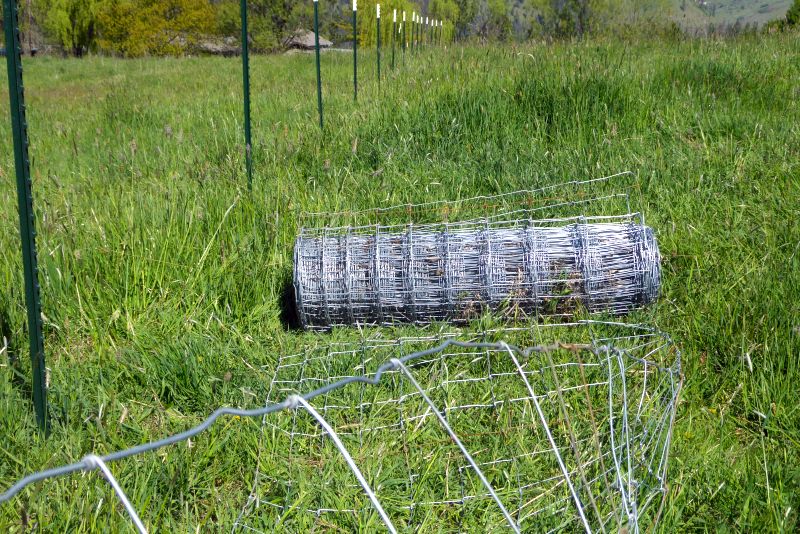
With that in mind, we gathered everything we needed. Thankfully we weren't faced with anything nearly as complex and difficult as fencing in the sacrifice pasture. In fact, we could bring all the heavy items (T-posts, roll of fencing, pounders, etc.) in the bucket of the tractor.

We unloaded everything and got ready to run a string.

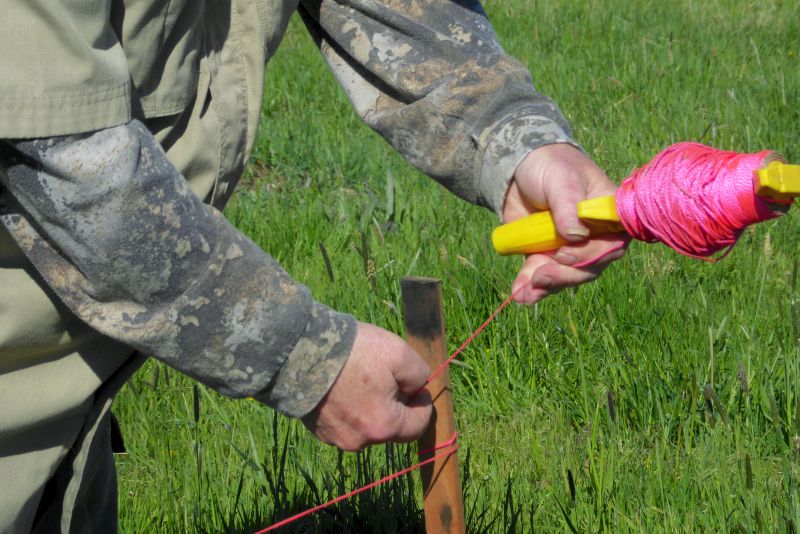
Because the pasture is sloped (everything on our property is sloped!), we hammered a stake just where the line of vision breaks between one end of the fence line and the other. Then we used the bright-pink string to mark the fence line.

(There's my handsome man on his iron steed!)

Then we dropped T-posts at 12-foot intervals and started pounding. The ground is still fairly soft, so it wasn't overly hard work. Don started at the top of the pasture, and I started at the bottom, the idea being to meet in the middle.

There was only one problem with this task: There's a ridge line of rock right where the fence line was passing through.

Don was frustrated by this impediment and started theorizing about building field-fence cages filled with rock to make gabions, which would be an enormous task. "Why not just make a jog in the fence line and go around the rocks?" I asked. Don laughed and said it goes against his thinking. "Men think linearly," he said, and admitted going around the outcrop hadn't even occurred to him.

So we jogged around the rocks. I did the T-post pounding in this section, and sometimes I had to reposition the posts irregularly whenever I hit a rock, but over all it wasn't bad. (You can see the still-unfenced garden in the center-left of the photo.)

Pounding that many T-posts was enough work for a couple of senior citizens for one day. The next day we commenced stretching the fencing. For obvious reasons we started at the top of the slope and worked downhill.

We unrolled the fencing until we got to the jog around the rock outcrop, and cut it. (Don pounded and wired some older and somewhat bent T-posts to the corners of the jog to make "king posts" for extra support. No photos, sorry.)

With the fencing unrolled, we needed to stretch it tight. We started by threading a metal bar through the fencing...

...and attached the bar to a chain. The bar threaded through the field fence allows us to impost more or less equal pressure on the entire stretch of fencing at the same time, without deforming individual squares of the field fence.

Then he attached the chain to the fence-puller, one of those extremely handy homestead tools.

The fence-puller straddles the gap between the fencing and an upright support (a T-post, in this case). By ratcheting the fence-puller, the fencing material is stretched until it's tight enough to wire the fencing in place to the T-posts all up the line.

Once the fencing was pulled tight, Don and I started wiring the fencing to the T-posts.

We fenced the jog as well, though we didn't use the fence-puller in this section for the task of pulling the fence tight.

This completed the bulk of the project. We still have some ancillary tasks (notably building strategically placed gates), but this subdivision should serve us well as we endeavor to rotate the cows through the summer grazing months.

(Bonus photos: Here's a rose bush we thankfully didn't have to work through when installing the fence.

Look at those horrible vicious thorns. Now you know why I postulated these were the thorns that surrounded Sleeping Beauty's castle.)


Wednesday, May 18, 2022

The green of our valley

Our spring has been very wet, and the little valley we live in is very green.

Interesting, a dominant grass right now is timothy, an excellent livestock feed. And boy howdy, is it full of pollen at the moment!

Here, Mr. Darcy is walking through the grass (the orange blur). Poof! Can you see the cloud of pollen?

Clearly this isn't good for anyone's allergies, but it's great for livestock potential. It's nice to see untended pastures full of decent grasses rather than noxious weeds such as hawk weed or star thistle.

Surprisingly few neighbors around here have livestock. A few horses, a couple of cows, and that's about it.

It's nice to know that when the time come to get our own livestock, they'll have decent forage.

Allergies notwithstanding.

Monday, September 27, 2021

Pasture requirements

A reader just sent in a question as follows: "I know it is just fall, but I am one those that plans ahead. Say in the spring I wanted just 4 cows, how much pasture minimum am I looking at?"

There is no cut-and-dried answer to this question because there are so many variables involved. Climate, latitude, rainfall, quality of vegetation, etc., all factor in. Pasture requirements differ between, say, Louisiana, Nevada, Wisconsin, and Maine.

Since I'm having a very busy week and don't have time to do this question justice – despite its importance – I thought I would let readers chime in with their advice and experience.

So let's hear your answers, folks. How much minimum pasture should this woman consider for four cows?

Monday, June 3, 2019

Thirty-second cattle roundup

Our pastures are looking lush and green, thanks to generous May rain.


We've been deliberately keeping the cows on the wooded side of our property to allow the pasture grass to grow abundantly. They also cropped the woods down to lawn proportions. Now it was time for the annual Thirty Second Cattle Roundup.

Opening the necessary gates, we called our universal cattle call (named after the first cow we ever owned): "Bossy bossy bossy bossy BOSSY!!!!"

Well oh my, the ladies knew what that meant! They came galloping up from the woods, through the feedlot...


...and poured out another gate toward the pasture.


Within moments, their heads were buried in the lush grass. Did I say thirty seconds? They might have topped that this year. Twenty seconds, max.


We'll let them fatten up for the next month. All but one of the ladies has a date with the freezer -- three near the beginning of July, the remaining three toward the end of July. (One heifer is sold.) It's far easier to move our household with the animals in packages than on the hoof.

Tuesday, March 13, 2018

The Brat Pack is complete

We only had one cow -- technically a heifer -- left to give birth to her calf. This was Pixie, Polly's adult calf.

She's been fooling me, this little lady. I've tucked her into the pen (which I'm coming to think of as the Birthing Chamber) a couple times, sure she was close to calving, but morning would come and no calf.

But yesterday her udder was very turgid, and she had a string of mucous hanging from her backside. No escaping it this time.


We'd been letting the animals down into the woods during the day, but they've still been hanging in the driveway in the evening. Yesterday evening came and Pixie was nowhere to be seen, so I walked down into the woods and found her in a thicket of leafless bushes. It's very normal for cows to go off by themselves to give birth, but Pixie is a first-time mother and there are coyotes around. I wanted her on firm ground with the rest of the cows nearby. She docilely let me herd her back into the driveway.

The weather has been very warm (it hit 60F today!) and the nights cool but not bitter, so it didn't bother me wherever Pixie choose to have her calf, as long as it was in the driveway area with the rest of the herd around. She settled right down for the night. I checked her just before I went to bed, and there were no signs of labor yet.

But this morning, I was not surprised to walk outside and see five, not four, calves. Pixie is now a mama.


Here's the new baby, a little girl we named Peggy (so the descendants go: Polly ==> Pixie ==> Peggy), wobbling right over another calf.


Here's Pixie, looking a little shell-shocked at her new role in life. Sometimes it takes new mamas a little while to get the hang of things.


But she was attentive enough. I think it helps to have other, more experienced cows around.


Then I fed all the animals breakfast under the awning, and Pixie was torn between wanting food and wanting to stay with her baby.


Baby?


Or breakfast?


Breakfast won. Hey, a gal has to keep her strength up.


So here we have the makings of a fine Brat Pack: Five little calves, born within a few weeks of each other. Can't you just see the mischief they'll be getting into?


In the meantime, Pixie showed signs of being a good mama.


For a little while, that is. Through a series of unfortunate events (namely, spring), one cow (Sparky) jumped a fence into another pasture, and eventually everyone ended up there for the day -- five cows, four calves.


Naughty Pixie had shucked off her responsibilities and left her baby in the driveway while she took advantage of the pasture (those calves aren't hers, by the way). Like a newborn fawn, it's often the habit of newborn calves to just hunker down and stay still when their mothers are away, so Peggy stayed in the driveway.


As evening drew near, Peggy needed her mama, so I scooped her up and put her in the barn pen, then put fresh food and water in the barn pen as well. Then we did our universal cattle call ("Bossy bossy bossy bossy bossy!!!") and got the herd near the gate. It was at this point Pixie remembered she had a calf, so we got her into the barn with her baby.

I was pleased to see Peggy nursing strongly. Once a calf nurses, its chances of survival are superb.


I'm afraid Pixie is in for a boring spell since we're going to keep her confined with Peggy. We have a day of rain moving in, and I want the newborn protected.


So that's the completion of our Brat Pack. In a few weeks these guys will be wreaking havoc. Such is spring.