Showing posts with label Memorial Day. Show all posts

Monday, May 29, 2023

How we spent our Memorial Day weekend

We spent our Memorial Day weekend saying goodbye to our military daughter.

We had a wonderful time during her visit, packing in as much as we could. Not just visits with old friends and taking a hiking trip, but engaging in endless conversations. She also fell in love with her parrot again.

On Saturday, I drove her to Spokane, where we spent the night in a hotel near the airport. On Sunday morning, still at the hotel, she made sure her dress-white uniform was neatly ironed.


Then I dropped her off at the airport, hugged her fiercely, and said goodbye.

The plan was for her to fly to the huge naval base in Norfolk, Virginia (with a layover in Denver), then take a military flight from Norfolk to Europe to report to her next duty station. But things went south in Denver when the flight to Norfolk was canceled.

Suddenly she's not only in limbo in Denver, but she's unable to fulfill her orders by reporting for duty. She's been trying to reach her Chain of Command in Europe (keeping in mind the time changes as well as the holiday, which U.S. service people observe even in other countries). The airline is only providing a single night's stay and two meals to compensate for the delay, even though the next flight to Norfolk isn't until Tuesday ... and the next military flight to Europe isn't until June 12!!

Anyway, the poor kid is trying to work through the entire mess. One of the things she's trying to do is contact the military travel organization to see if they'll authorize her a commercial flight to Europe.

So yeah, that's how we spent our Memorial Day weekend.

Meanwhile, a mighty "thank you" to our past and present veterans, whose sacrifices too many of us are willing to overlook, dismiss, or forget.

Monday, May 30, 2022

Memorial Day

As I often do on Memorial Day, I like to draw your attention to a set of remarkable photos taken a few years ago by a reader (Katie) and her husband, who were formerly stationed in Germany. Katie learned that Don's uncle, Donald Sowers, who was killed in World War II, was buried in Ardennes American Cemetery in Liege, Belgium. She and her family visited the cemetery and sent these photos. (The entire collection can be seen here. Go look at them. They're remarkable.)


Later, a reader named Kathy left the following moving comment on that blog post I shared:

I searched for 2 years to find my mother's first husband Harold Norris, killed 4/4/44 @ 2:04 PM over Romania. I received a photo of his grave from Belgium and walked over to my mother's home and said, "Mom, where is Harold buried?" She said, "New Jersey". I said, "Mom, sit down, we need to talk."

Her mouth dropped open when she learned that her first husband was buried in Belgium! He has been there for (then) 65 years. All I started with was his purple heart, his name and service number. It has lead me down a path filled with new compassionate friends and a new understanding of the word sacrifice. Harold was an airman, navigator and top turret gunner. His plane the Miasis Dragon was shot down after delivering a fatal blow to an oil refinery in Bucharest Romania. The plane was hit at the waist by a land-to-air missile. The plane nose dipped, the pilot pulled it up, then it went nose-over-tail to the earth in a fireball. 4 crew were "carbonized" and were buried together in one grave by Romanian Monks. Later, in 1949, with dental records my mother provided, the US was able to locate his remains from the others and he was buried for the 9th and final time in Ardennes. The other 3 airmen are still together buried in the US.

One of the beautiful things I noticed was that each man's life is symbolized with a marble cross. They all worked and sacrificed as a group and from above, all of their individual crosses make up a larger cross. This collective larger cross can only be seen by people in airplanes and God. 3/5ths of the graves hold the remains from airmen who lost their lives....it is to those who fly that the larger cross is visible...a beautiful way to honor them.

The other thing I learned in 2010: the people of Belgium, France and other countries meet and honor our heroes. At Ardennes in 2010, there was approximately 100,000 people present, not many were from the USA. It seems that in life, we considered these men to belong to us, but in their death, the European people consider that these men belong to them, whom they thank and honor every year. Most graves have been adopted. Harold's grave was adopted many years ago and now the lady who adopted his grave is teaching her young grand daughter to care for it. She obviously does not want her grand daughter to forget the gratitude she has for the men who lost their lives saving hers.

I wrote to a man who was age 7 when the bombs were falling on to his town. He was scared and saw more than a 7-year-old should see. He remembers the American forces and he remembers liberation. For those who know what happened, who saw the cruelty and oppression, who had no hope, our US Military saved them, their children and their grand children. The maximum gift was given, freedom was restored at a great price, those receiving the gift are grateful....and other airmen and God can see their collective cross, a memorial for their sacrifice, from the air. This has put many things in perspective for me...I hope it will for you too. --Kathy

_______________________________

This is an essay Don wrote many years ago in tribute to his fallen uncle:

Forever Young

I don't know how he died, really. No one does, since everyone who was with him died at more or less the same time.

I'll bet he was afraid. I would have been.

It must have been hell on earth – above earth to be exact. A booming, banging, grinding, shaking, shattering horror. Especially it must have been tough on him, hanging as he was below the belly of a crippled plane, a bubble of glass exposed to the flak and the fire from enemy aircraft. A tasty and too-visible target.

His B-24 Liberator was powerful, true. But it was also lightly armored and easily damaged in combat. When damaged, the B-24 often lost the electrical power needed to rotate its gun turrets, and the gunners would have to hand-crank their turrets around, trying to follow the enemy planes.

Too slow. Too slow.

He was probably the youngest man on board. He was certainly the lowest-ranking member of the ten men who made up the crew. That first day of August in 1943, he'd only been in the Army Air Corp for a year and a half. He'd only been overseas for six months. He was 19 years old. He came from a farming family that lived in a very small town in Kansas. He had one sister, two brothers, and two very worried parents.

He was assigned to 98BG, a bomber group stationed out of Benghazi, Libya. His mission that day? In coordination with 178 bombers and 1,700 crew members, the 98BG was to attack and destroy the oil refineries at Ploesti, Romania. These facilities provided the Third Reich with one-third of its fuel … and the Nazis were very hungry for fuel in the waning days of 1943.

The oil refineries at Ploesti were protected with massive anti-aircraft batteries and hundreds of German and Romanian fighter planes. The distance traveled by the Allied bombers meant that no fighter protection could attend them. They were alone.
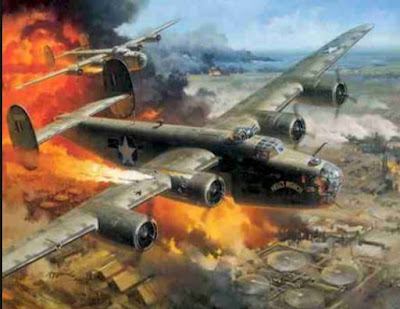
"Fire over Ploesti" by Roy Grinnell

It was a tremendous undertaking, a gamble of men and machines desperately needed for the war effort. A 2,400 mile, eighteen hour trip there and back again, with only a half-hour of available time over the target.

And in the end, for over 500 airmen and 52 bombers, there was no going home.

They say he's buried at a cemetery near Liege, Belgium. Maybe he is, maybe he isn't. The records show that his B-24 was shot down over the refinery, but that it happened before the crew could disgorge the plane's 8000-pound payload of high explosives. And the B-24 Liberator was well known for burning merrily when it crashed.

But his name is on one of the white crosses standing in formation at the lovingly well-tended cemetery.

His parents back in Kansas received the medals that he was awarded posthumously at a ceremony, probably one of many such ceremonies on that same day. The medals were: a Distinguished Flying Cross, a Purple Heart, and the Air Medal with three oak leaf clusters.

Both his brothers eventually went to war as well. One went as another tail gunner, the other as a pilot. His younger sister stayed home, grieving for the older brother she would never see again on this side.

Eventually she married my father.

The parents, the brothers, and the sister passed away some time ago. There is now no one who can tell me anything more about Donald Phillip Sowers – Sargent, United States Army Air Corp. The uncle I never knew and whose name I share.

Donald Philip Sowers never woke to the face of his bride on the day after his wedding. He never paced the floor late at night singing softly to an infant daughter who just couldn't sleep. He never got to hold his child's hand the last time she needed, or wanted, help to cross a street. He never felt the aches and pains of a long life, well lived. And well loved.

But I will remember him and so will my children. If you've taken the time to read this, tip a glass in his name and remember him. And all the other lost brothers and sisters as well.

Think of the things he missed, for the things you have.

Donald Philip Sowers died fighting the greatest evil of our time – a young man of 19 who will never grow old.
_______________________________

A mighty "thank you" to our past and present veterans, whose sacrifices too many of us are willing to overlook, dismiss, or forget.

Monday, May 25, 2020

Memorial Day

As I often do on Memorial Day, I like to draw your attention to a set of remarkable photos taken a few years ago by a reader (Katie) and her husband, who were formerly stationed in Germany. Katie learned that Don's uncle, Donald Sowers, who was killed in World War II, was buried in Ardennes American Cemetery in Liege, Belgium. She and her family visited the cemetery and sent these photos.


Last year, a reader named Kathy left the following moving comment on that blog post I shared:

I searched for 2 years to find my mother's first husband Harold Norris, killed 4/4/44 @ 2:04 PM over Romania. I received a photo of his grave from Belgium and walked over to my mother's home and said, "Mom where is Harold buried?" She said, "New Jersey". I said, "Mom, sit down, we need to talk."

Her mouth dropped open when she learned that her first husband was buried in Belgium! He has been there for (then) 65 years. All I started with was his purple heart, his name and service number. It has lead me down a path filled with new compassionate friends and a new understanding of the word sacrifice. Harold was an airman, navigator and top turret gunner. His plane the Miasis Dragon was shot down after delivering a fatal blow to an oil refinery in Bucharest Romania. The plane was hit at the waist by a land-to-air missile. The plane nose dipped, the pilot pulled it up, then it went nose-over-tail to the earth in a fireball. 4 crew were "carbonized" and were buried together in one grave by Romanian Monks. Later, in 1949, with dental records my mother provided, the US was able to locate his remains from the others and he was buried for the 9th and final time in Ardennes. The other 3 airmen are still together buried in the US.

One of the beautiful things I noticed was that each man's life is symbolized with a marble cross. They all worked and sacrificed as a group and from above, all of their individual crosses make up a larger cross. This collective larger cross can only be seen by people in airplanes and God. 3/5ths of the graves hold the remains from airmen who lost their lives....it is to those who fly that the larger cross is visible...a beautiful way to honor them.

The other thing I learned in 2010: the people of Belgium, France and other countries meet and honor our heroes. At Ardennes in 2010, there was approximately 100,000 people present, not many were from the USA. It seems that in life, we considered these men to belong to us, but in their death, the European people consider that these men belong to them, whom they thank and honor every year. Most graves have been adopted. Harold's grave was adopted many years ago and now the lady who adopted his grave is teaching her young grand daughter to care for it. She obviously does not want her grand daughter to forget the gratitude she has for the men who lost their lives saving hers.

I wrote to a man who was age 7 when the bombs were falling on to his town. He was scared and saw more than a 7 year old should see. He remembers the American forces and he remembers liberation. For those who know what happened, who saw the cruelty and oppression, who had no hope, our US Military saved them, their children and their grand children. The maximum gift was given, freedom was restored at a great price, those receiving the gift are grateful....and other airmen and God can see their collective cross, a memorial for their sacrifice, from the air. This has put many things in perspective for me...I hope it will for you too. --Kathy

_______________________________

This is an essay Don wrote many years ago in tribute to his fallen uncle:

Forever Young

I don't know how he died, really. No one does, since everyone who was with him died at more or less the same time.

I'll bet he was afraid. I would have been.

It must have been hell on earth – above earth to be exact. A booming, banging, grinding, shaking, shattering horror. Especially it must have been tough on him, hanging as he was below the belly of a crippled plane, a bubble of glass exposed to the flak and the fire from enemy aircraft. A tasty and too-visible target.

His B-24 Liberator was powerful, true. But it was also lightly armored and easily damaged in combat. When damaged, the B-24 often lost the electrical power needed to rotate its gun turrets, and the gunners would have to hand-crank their turrets around, trying to follow the enemy planes.

Too slow. Too slow.

He was probably the youngest man on board. He was certainly the lowest-ranking member of the ten men who made up the crew. That first day of August in 1943, he'd only been in the Army Air Corp for a year and a half. He'd only been overseas for six months. He was 19 years old. He came from a farming family that lived in a very small town in Kansas. He had one sister, two brothers, and two very worried parents.

He was assigned to 98BG, a bomber group stationed out of Benghazi, Libya. His mission that day? In coordination with 178 bombers and 1,700 crew members, the 98BG was to attack and destroy the oil refineries at Ploesti, Romania. These facilities provided the Third Reich with one-third of its fuel … and the Nazis were very hungry for fuel in the waning days of 1943.

The oil refineries at Ploesti were protected with massive anti-aircraft batteries and hundreds of German and Romanian fighter planes. The distance traveled by the Allied bombers meant that no fighter protection could attend them. They were alone.

"Fire over Ploesti" by Roy Grinnell

It was a tremendous undertaking, a gamble of men and machines desperately needed for the war effort. A 2,400 mile, eighteen hour trip there and back again, with only a half-hour of available time over the target.

And in the end, for over 500 airmen and 52 bombers, there was no going home.

They say he's buried at a cemetery near Liege, Belgium. Maybe he is, maybe he isn't. The records show that his B-24 was shot down over the refinery, but that it happened before the crew could disgorge the plane's 8000-pound payload of high explosives. And the B-24 Liberator was well known for burning merrily when it crashed.

But his name is on one of the white crosses standing in formation at the lovingly well-tended cemetery.

His parents back in Kansas received the medals that he was awarded posthumously at a ceremony, probably one of many such ceremonies on that same day. The medals were: a Distinguished Flying Cross, a Purple Heart, and the Air Medal with three oak leaf clusters.

Both his brothers eventually went to war as well. One went as another tail gunner, the other as a pilot. His younger sister stayed home, grieving for the older brother she would never see again on this side.

Eventually she married my father.

The parents, the brothers, and the sister passed away some time ago. There is now no one who can tell me anything more about Donald Phillip Sowers – Sargent, United States Army Air Corp. The uncle I never knew and whose name I share.

Donald Philip Sowers never woke to the face of his bride on the day after his wedding. He never paced the floor late at night singing softly to an infant daughter who just couldn't sleep. He never got to hold his child's hand the last time she needed, or wanted, help to cross a street. He never felt the aches and pains of a long life, well lived. And well loved.

But I will remember him and so will my children. If you've taken the time to read this, tip a glass in his name and remember him. And all the other lost brothers and sisters as well.

Think of the things he missed, for the things you have.

Donald Philip Sowers died fighting the greatest evil of our time – a young man of 19 who will never grow old.
_______________________________

A mighty "thank you" to our past and present veterans, whose sacrifices too many of us are willing to overlook, dismiss, or forget.

Tuesday, May 28, 2019

A brush with history

Older Daughter called yesterday (Monday). As you might recall, she works as a nanny in New Jersey, and frequently on weekends will travel down to Virginia to visit her friend GG. She was on her way back from that visit when she called to chat. I put her on speaker phone so Don could hear the conversation as well.

During our phone call, she related an interesting anecdote. On Sunday morning, she and GG were going to go do something after church, so they drove in separately from GG's parents, with the idea everyone would meet up at church. During the drive, Older Daughter noticed a LOT of police officers around; and whenever they drove under an overpass, they noticed crowds of people on the bridges, with flags and banners. What was going on?

But they didn't think much about it. They got to church and reserved some seats for GG's parents -- who never showed up, even though they only left the house five minutes after Older Daughter and GG. Where could they be?

Eventually, halfway through church, GG got a text from her parents saying the highway -- the same four-lane highway Older Daughter had just driven five minutes ahead -- was now CLOSED for some huge event that would shortly take place. All within that five-minute time gap. What event would close a four-lane highway?

"Rolling Thunder," Don called from the other room.


Rolling Thunder, it seems, is a massive -- as in, hundreds of thousands of participants -- motorcycle rally consisting of veterans and veteran supporters which descends on Washington D.C. every Memorial Day weekend. I'd never really paid attention to it before because I'm not into motorcycles, but it's been going on for years and years and years. According to their website, "All [participants] are united in the cause to bring full accountability for the Prisoners Of War-Missing In Action (POW/MIA) of all wars, reminding the government, the media and the public by our watchwords: 'We Will Not Forget.'"


Wow. Just ... wow.

This would explain the extra law enforcement presence Older Daughter and GG saw, as well as the crowds of people lining the overpasses.


Now for an interesting "rest of the story." Apparently this was anticipated to be Rolling Thunder's final ride into Washington D.C., citing expenses and harassment. According to the New York Post, reasons to discontinue the rally included "the Pentagon Security Police/Washington Police officials continued lack of cooperation, increased harassment to our supporters and sponsors. ... Rolling Thunder is poised to keep losing money on the rally due to demands from the Pentagon for extra security, among other issues."

But President Trump threw in his support, and now it looks like the rally will continue. "Good for Trump," said Younger Daughter, when Don relayed that information.

I told Older Daughter she just had a faint brush with history.


Roll on, Rolling Thunder. What an awesome spectacle.

Monday, May 27, 2019

Memorial Day

On this Memorial Day, I'd like to draw your attention to a set of remarkable photos taken a few years ago by a reader (Katie) and her husband, who were formerly stationed in Germany. Katie learned that Don's uncle, Donald Sowers, who was killed in World War II, was buried in Ardennes American Cemetery in Liege, Belgium. She and her family visited the cemetery and sent these photos.


Just recently a reader named Kathy left the following moving comment on that blog post which I wanted to share:

I searched for 2 years to find my mother's first husband Harold Norris, killed 4/4/44 @ 2:04 PM over Romania. I received a photo of his grave from Belgium and walked over to my mother's home and said, "Mom where is Harold buried?" She said, "New Jersey". I said, "Mom, sit down, we need to talk."

Her mouth dropped open when she learned that her first husband was buried in Belgium! He has been there for (then) 65 years. All I started with was his purple heart, his name and service number. It has lead me down a path filled with new compassionate friends and a new understanding of the word sacrifice. Harold was an airman, navigator and top turret gunner. His plane the Miasis Dragon was shot down after delivering a fatal blow to an oil refinery in Bucharest Romania. The plane was hit at the waist by a land-to-air missile. The plane nose dipped, the pilot pulled it up, then it went nose-over-tail to the earth in a fireball. 4 crew were "carbonized" and were buried together in one grave by Romanian Monks. Later, in 1949, with dental records my mother provided, the US was able to locate his remains from the others and he was buried for the 9th and final time in Ardennes. The other 3 airmen are still together buried in the US.

One of the beautiful things I noticed was that each man's life is symbolized with a marble cross. They all worked and sacrificed as a group and from above, all of their individual crosses make up a larger cross. This collective larger cross can only be seen by people in airplanes and God. 3/5ths of the graves hold the remains from airmen who lost their lives....it is to those who fly that the larger cross is visible...a beautiful way to honor them.

The other thing I learned in 2010: the people of Belgium, France and other countries meet and honor our heroes. At Ardennes in 2010, there was approximately 100,000 people present, not many were from the USA. It seems that in life, we considered these men to belong to us, but in their death, the European people consider that these men belong to them, whom they thank and honor every year. Most graves have been adopted. Harold's grave was adopted many years ago and now the lady who adopted his grave is teaching her young grand daughter to care for it. She obviously does not want her grand daughter to forget the gratitude she has for the men who lost their lives saving hers.

I wrote to a man who was age 7 when the bombs were falling on to his town. He was scared and saw more than a 7 year old should see. He remembers the American forces and he remembers liberation. For those who know what happened, who saw the cruelty and oppression, who had no hope, our US Military saved them, their children and their grand children. The maximum gift was given, freedom was restored at a great price, those receiving the gift are grateful....and other airmen and God can see their collective cross, a memorial for their sacrifice, from the air. This has put many things in perspective for me...I hope it will for you too. --Kathy

_______________________________

A mighty "thank you" to our past and present veterans, whose sacrifices too many of us are willing to overlook, dismiss, or forget.

Monday, May 28, 2018

Forever Young

On this Memorial Day, here is an essay Don wrote several years ago as a tribute to an uncle he never met but for whom he was named. His mother's older brother, Donald Sowers, died in World War II.


Forever Young

I don't know how he died, really. No one does, since everyone who was with him died at more or less the same time.

I'll bet he was afraid. I would have been.

It must have been hell on earth – above earth to be exact. A booming, banging, grinding, shaking, shattering horror. Especially it must have been tough on him, hanging as he was below the belly of a crippled plane, a bubble of glass exposed to the flak and the fire from enemy aircraft. A tasty and too-visible target.

His B-24 Liberator was powerful, true. But it was also lightly armored and easily damaged in combat. When damaged, the B-24 often lost the electrical power needed to rotate its gun turrets, and the gunners would have to hand-crank their turrets around, trying to follow the enemy planes.

Too slow. Too slow.

He was probably the youngest man on board. He was certainly the lowest-ranking member of the ten men who made up the crew. That first day of August in 1943, he'd only been in the Army Air Corp for a year and a half. He'd only been overseas for six months. He was 19 years old. He came from a farming family that lived in a very small town in Kansas. He had one sister, two brothers, and two very worried parents.

He was assigned to 98BG, a bomber group stationed out of Benghazi, Libya. His mission that day? In coordination with 178 bombers and 1,700 crew members, the 98BG was to attack and destroy the oil refineries at Ploesti, Romania. These facilities provided the Third Reich with one-third of its fuel … and the Nazis were very hungry for fuel in the waning days of 1943.

The oil refineries at Ploesti were protected with massive anti-aircraft batteries and hundreds of German and Romanian fighter planes. The distance traveled by the Allied bombers meant that no fighter protection could attend them. They were alone.

"Fire over Ploesti" by Roy Grinnell

It was a tremendous undertaking, a gamble of men and machines desperately needed for the war effort. A 2,400 mile, eighteen hour trip there and back again, with only a half-hour of available time over the target.

And in the end, for over 500 airmen and 52 bombers, there was no going home.

They say he's buried at a cemetery near Liege, Belgium. Maybe he is, maybe he isn't. The records show that his B-24 was shot down over the refinery, but that it happened before the crew could disgorge the plane's 8000-pound payload of high explosives. And the B-24 Liberator was well known for burning merrily when it crashed.

But his name is on one of the white crosses standing in formation at the lovingly well-tended cemetery.

His parents back in Kansas received the medals that he was awarded posthumously at a ceremony, probably one of many such ceremonies on that same day. The medals were: a Distinguished Flying Cross, a Purple Heart, and the Air Medal with three oak leaf clusters.

Both his brothers eventually went to war as well. One went as another tail gunner, the other as a pilot. His younger sister stayed home, grieving for the older brother she would never see again on this side.

Eventually she married my father.

The parents, the brothers, and the sister passed away some time ago. There is now no one who can tell me anything more about Donald Phillip Sowers – Sargent, United States Army Air Corp. The uncle I never knew and whose name I share.

Donald Philip Sowers never woke to the face of his bride on the day after his wedding. He never paced the floor late at night singing softly to an infant daughter who just couldn't sleep. He never got to hold his child's hand the last time she needed, or wanted, help to cross a street. He never felt the aches and pains of a long life, well lived. And well loved.

But I will remember him and so will my children. If you've taken the time to read this, tip a glass in his name and remember him. And all the other lost brothers and sisters as well.

Think of the things he missed, for the things you have.

Donald Philip Sowers died fighting the greatest evil of our time – a young man of 19 who will never grow old.


A few years after WND printed this column, a blog reader contacted us. She had visited the Ardennes American Cemetery in Liege, Belgium, and found the grave of my husband’s uncle. She kindly sent us many photographs of the cemetery in general and his tomb marker in particular. They are moving beyond words.


Too many people have no idea what Memorial Day really is. It’s become a day to welcome summer: a day for barbecues, for beer, for picnics, for an extra day off work.

But that wasn’t the original intent. Memorial Day was meant to remember those who died preserving our freedom. Can we remember? Or will we now let those freedoms wither in our brave new world of social justice warriors too cowardly to face real threats?


A mighty "thank you" to our past and present veterans, whose sacrifices too many of us are willing to overlook, dismiss, or forget.

A safe and thoughtful Memorial Day to everyone.

Monday, May 30, 2016

Memorial Day

On this Memorial Day, I'd like to draw your attention to a set of remarkable photos taken a few years ago by a reader (Katie) and her husband, who were formerly stationed in Germany. Katie learned that Don's uncle, Donald Sowers, who was killed in World War II, was buried in Ardennes American Cemetery in Liege, Belgium. She and her family visited the cemetery and sent these photos.


Later a reader named Kathy left a comment on that blog post which I like to share:

I searched for 2 years to find my mother's first husband Harold Norris, killed 4/4/44 @ 2:04 PM over Romania. I received a photo of his grave from Belgium and walked over to my mother's home and said, "Mom where is Harold buried?" She said, "New Jersey". I said, "Mom, sit down, we need to talk."

Her mouth dropped open when she learned that her first husband was buried in Belgium! He has been there for (then) 65 years. All I started with was his purple heart, his name and service number. It has lead me down a path filled with new compassionate friends and a new understanding of the word sacrifice. Harold was an airman, navigator and top turret gunner. His plane the Miasis Dragon was shot down after delivering a fatal blow to an oil refinery in Bucharest Romania. The plane was hit at the waist by a land-to-air missile. The plane nose dipped, the pilot pulled it up, then it went nose-over-tail to the earth in a fireball. 4 crew were "carbonized" and were buried together in one grave by Romanian Monks. Later, in 1949, with dental records my mother provided, the US was able to locate his remains from the others and he was buried for the 9th and final time in Ardennes. The other 3 airmen are still together buried in the US.

One of the beautiful things I noticed was that each man's life is symbolized with a marble cross. They all worked and sacrificed as a group and from above, all of their individual crosses make up a larger cross. This collective larger cross can only be seen by people in airplanes and God. 3/5ths of the graves hold the remains from airmen who lost their lives....it is to those who fly that the larger cross is visible...a beautiful way to honor them.

The other thing I learned in 2010: the people of Belgium, France and other countries meet and honor our heroes. At Ardennes in 2010, there was approximately 100,000 people present, not many were from the USA. It seems that in life, we considered these men to belong to us, but in their death, the European people consider that these men belong to them, whom they thank and honor every year. Most graves have been adopted. Harold's grave was adopted many years ago and now the lady who adopted his grave is teaching her young grand daughter to care for it. She obviously does not want her grand daughter to forget the gratitude she has for the men who lost their lives saving hers.

I wrote to a man who was age 7 when the bombs were falling on to his town. He was scared and saw more than a 7 year old should see. He remembers the American forces and he remembers liberation. For those who know what happened, who saw the cruelty and oppression, who had no hope, our US Military saved them, their children and their grand children. The maximum gift was given, freedom was restored at a great price, those receiving the gift are grateful....and other airmen and God can see their collective cross, a memorial for their sacrifice, from the air. This has put many things in perspective for me...I hope it will for you too. --Kathy

_______________________________

A mighty "thank you" to our past and present veterans, whose sacrifices too many of us are willing to overlook, dismiss, or forget.

Monday, May 25, 2015

Memorial Day

Words are inadequate to thank veterans for their service and sacrifice.


But I'll try.


THANK YOU.


Monday, May 26, 2014

A somber reminder

On this Memorial Day, I'd like to draw your attention to a set of remarkable photos taken a few years ago by a reader (Katie) and her husband, who were formerly stationed in Germany. Katie learned that Don's uncle, Donald Sowers, who was killed in World War II, was buried in Ardennes American Cemetery in Liege, Belgium. She and her family visited the cemetery and sent these photos.


Just recently a reader named Kathy left the following moving comment on that blog post which I wanted to share:

I searched for 2 years to find my mother's first husband Harold Norris, killed 4/4/44 @ 2:04 PM over Romania. I received a photo of his grave from Belgium and walked over to my mother's home and said, "Mom where is Harold buried?" She said, "New Jersey". I said, "Mom, sit down, we need to talk."

Her mouth dropped open when she learned that her first husband was buried in Belgium! He has been there for (then) 65 years. All I started with was his purple heart, his name and service number. It has lead me down a path filled with new compassionate friends and a new understanding of the word sacrifice. Harold was an airman, navigator and top turret gunner. His plane the Miasis Dragon was shot down after delivering a fatal blow to an oil refinery in Bucharest Romania. The plane was hit at the waist by a land-to-air missile. The plane nose dipped, the pilot pulled it up, then it went nose-over-tail to the earth in a fireball. 4 crew were "carbonized" and were buried together in one grave by Romanian Monks. Later, in 1949, with dental records my mother provided, the US was able to locate his remains from the others and he was buried for the 9th and final time in Ardennes. The other 3 airmen are still together buried in the US.

One of the beautiful things I noticed was that each man's life is symbolized with a marble cross. They all worked and sacrificed as a group and from above, all of their individual crosses make up a larger cross. This collective larger cross can only be seen by people in airplanes and God. 3/5ths of the graves hold the remains from airmen who lost their lives....it is to those who fly that the larger cross is visible...a beautiful way to honor them.

The other thing I learned in 2010: the people of Belgium, France and other countries meet and honor our heroes. At Ardennes in 2010, there was approximately 100,000 people present, not many were from the USA. It seems that in life, we considered these men to belong to us, but in their death, the European people consider that these men belong to them, whom they thank and honor every year. Most graves have been adopted. Harold's grave was adopted many years ago and now the lady who adopted his grave is teaching her young grand daughter to care for it. She obviously does not want her grand daughter to forget the gratitude she has for the men who lost their lives saving hers.

I wrote to a man who was age 7 when the bombs were falling on to his town. He was scared and saw more than a 7 year old should see. He remembers the American forces and he remembers liberation. For those who know what happened, who saw the cruelty and oppression, who had no hope, our US Military saved them, their children and their grand children. The maximum gift was given, freedom was restored at a great price, those receiving the gift are grateful....and other airmen and God can see their collective cross, a memorial for their sacrifice, from the air. This has put many things in perspective for me...I hope it will for you too. --Kathy

_______________________________

A mighty "thank you" to our past and present veterans, whose sacrifices too many of us are willing to overlook, dismiss, or forget.

Monday, May 27, 2013

Memorial Day

Words are inadequate to thank veterans for their service and sacrifice.


But I'll try.


THANK YOU.


Monday, May 28, 2012

Freedom isn't free


It is the veteran, not the preacher, who has given us freedom of religion.

It is the veteran, not the reporter, who has given us freedom of the press.

It is the veteran, not the poet, who has given us freedom of speech.


It is the veteran, not the community organizer, who has given us freedom to assemble.

It is the veteran, not the lawyer, who has given us the right to a fair trial.

It is the veteran, not the politician, who has given us the right to vote.


Remember - only two defining forces have ever offered to die for you, Jesus Christ and the American GI. One died for your soul, the other for your freedom.

Friday, October 14, 2011

Ardennes American Cemetery in Liege, Belgium

Quite awhile ago, my husband wrote a piece called Forever Young to memorialize his uncle who died in World War II. Tears spring to my eyes whenever I read this piece, and I've read it many times. My husband never met the man whose name he shares, and who died many years before he was born.

Now here's something unbelievable. One of my readers -- Katie J., whose husband Mike is stationed in Germany -- emailed me a few weeks ago and asked if we would like her to take photos of Don's uncle's burial place in Ardennes American Cemetery in Liege, Belgium.

Oh my gosh, Don was thrilled! Katie's husband, Mike, is the photographer, and these shots are incredibly moving.

Each of these markers represents a life lost, a family shattered, a loved one in mourning... and a world, saved.

Here are the photos, along with some comments by Katie.
______________________________

Front side.


This picture shows the beautiful symmetry of the cemetery.


This statue of a youth was included at the cemetery since most of the soldiers were in the prime of their lives.


Don's uncle.


This is a picture of a picture. Mike snapped this when we were in the visitor's center. I had not been able to grasp the cross shape from my view point, so I was very glad for this aerial shot.


These pictures are the back of the Memorial.


Here is a side view of the Memorial. The kids and I are looking at the plaques that list the names of the soldiers who gave their lives yet had no remains to bury.


Here is a closer picture of those plaques.


Here is the info on CPT Darrell Lindsey. There were at least 3 Medal of Honor recipients buried at Ardennes.


Sections A and C (in the background). If you look carefully, you can see a sort of "hiccup" in the crosses where the sidewalk is between the sections. Also you can see the Jewish Stars of David on some of the markers.


Forgot to say in the aerial view, the cemetery was divided into 4 sections, A through D. The sections were divided by the walkways and laid out like this: CD AB (viewed from the "front") Your uncle's cross was in the very first row of the C section, the 28th from the right. This picture is a view of sections B & D with the flag in the back. I know it's not your uncle's section, but I thought the flag in the back was a very somber shot.


Sadly, there are far too many of these crosses. (The inscription says: Here rests in honored glory a Comrade in Arms, known but to God.)


When you walk into the memorial, the altar is the first thing you see. We said a prayer for your Uncle, as well as for all past and current soldiers.


This is the wall above the entry way.


The other three walls inside the Memorial are filled with maps. This is the wall on the right as you enter.


This is the wall on the left as you enter.


The view of the Memorial from your Uncle's marker.


View of the flag from your Uncle's marker.


I had asked Mike to take a picture of your Uncle "among the other soldiers." [Note from Patrice: this is my favorite photo.]


The enormity of lives lost is overwhelming on views like this :(


View of the Memorial from the Flag. (The caretakers were out in force on the day we visited.)

_____________________________________

In the mists of time, it's far too easy to forget the evils that threatened our world during World War II. Belgium -- along with other European countries -- is to be commended for maintaining such a beautiful cemetery and honoring the soldiers who died in their defense. Sometimes these soldiers didn't even have remains to bury. In that respect, Don's uncle was luckier than some.

To Katie and her husband, both Don and I thank you from the bottoms of our hearts for making the time and effort to take these photos. They are magnificent. We are never likely to visit Belgium, much less Liege, so these photos will be passed around to family members on the Sowers side.

And to all the men and women who are serving our country and protecting us from the evils that still threaten our world: THANK YOU.